• Home
  • About
  • Services
  • Contact

Leadership in Transportation

~ John L. Craig Consulting, LLC

Leadership in Transportation

Category Archives: Performance Measurement and Management

We Will Succeed or Fail—Together: caring for our built-natural environment (Part 3 The Future: Some Background for Program Management)

13 Saturday May 2023

Posted by John L. Craig in Biological Diversity, Built Environment, Business Transformation, Clean Energy, Climate, Collaboration, Construction, Design, Economics, Economy, Education, Empowering Women, Environment, Environmental Justice, Extinction of Species, Feedback Loops, Future, Governance, Government & Policy, Growth, Homo sapiens, Human Rights, Inequality, Infrastructure, Investing, Leadership, Natural Environment, Partnerships and Collaboration, Performance Measurement and Management, Planning, Poverty, Program Management, Project Management, Relationships, Resilience, Results, Return on Investment or ROI, Risks, Social Justice and Equity, Society, Strategic Planning, Sustainability, Systems Thinking, Technology, Well-being

≈ Leave a comment

The world is overwhelmingly short-term focused, and no one really knows what the future holds as the global built-natural environment evolves. It likely will be more or less recognizable compared to today. Many of us, but not all, have enjoyed living in a high-quality built environment/standard of living while our natural environment has degraded, largely unnoticed by many. Changes to our built-natural environment will likely not happen quickly but over decades, centuries, and millennia (if this isn’t considered quickly, which is a relative term). During this time, our built-natural environment is poised for significant change, some for the worse and hopefully some for the better (World Economic Forum, 2023). There is also the Doomsday Clock, originally established with the involvement of Albert Einstein to approximate humanity’s end from nuclear weapons. It has since been expanded to include other threats, and that clock keeps moving forward toward midnight (Weise, 2023a). There are also dire predictions from credible sources and acknowledgment that it is too late to fully prevent the resulting impacts (Jazeera, 2023, Ripple et al., 2023; Sumata, 2023). These predictions include ones from a Nobel Peace Prize-winning collection of scientists and perhaps the greatest group of scientists ever assembled—the International Governmental Panel on Climate Change or IPCC (2023). The press has highlighted this report (e.g., 9News, 2023; Borenstein and Jordans, 2023; Rice and Pulver, 2023). Others forecast variations on this future, but they are not substantially different (Barrage and Nordhaus, 2023; Watts, 2023; van der Wijst et al., 2023). These are in addition to the prescient 1972 Limits to Growth projections (Meadows et al., 1972), updates and various off-shoot initiatives (Bardi and Pereira, 2022; Herrington 2022), and myriad associated efforts (We Don’t Have Time, nd) that have precipitated this four-part series. There are also more optimistic outlooks based on currently available technologies (Weise, 2023b). Although somewhat dated, one study found that not one of 150 countries meets basic needs of its citizens at a globally sustainable level of resource use (O’Neill et al., 2018). An interesting link is also provided with this citation (O’Neill et al., 2018) that provides a comparison of various resource usage for these 150 countries. Ultimately, no one precisely knows what the future holds, although the facts and trend lines of the risks to our global society, economy, and built and natural environments appear indisputable. Thus, it may be best to view these various scenarios within a “cone of possibilities” while planning and preparing for the worst.

Some projections are that sea level will rise 12 inches by 2050 (National Oceanic and Atmospheric Administration, 2022a). That’s less than 27 years from now. Ten percent of the world’s population live in coastal areas less than 32 feet above sea level (Bressan, 2021), 267 million are less than six feet above sea level, 44 percent live within about 90 miles of the coast, and eight of the ten largest cities in the world are near a coast (National Oceanic and Atmospheric Administration, 2022b). This does not consider more intense storms (marine and terrestrial) from increased heat in the oceans and the atmosphere. Biodiversity extinction continues at alarming rates (70 percent of wildlife is already lost). That diversity is the basis of a healthy planetary ecosystem for all living things, including humans.

Biodiversity encompasses the living nature in all its variety. It provides many services, including climate regulation, pollination and soil formation, decomposing wastes, provision of raw materials, and contributions to our mental and physical well-being. There are three dimensions to biodiversity: ecosystems, species, and genetics. More than 90% of biodiversity loss is caused by five drivers: land degradation and habitat destruction, resource (over) exploitation, climate change, pollution, and invasive species.”

Avice-Hyet and Petit, 2023

It’s hard to estimate other high risks, including continuing wars such as in Ukraine. The coming decade will largely find whether we will succeed or fail in maintaining a quality, built-natural environment for all within a healthy global ecosystem.

Politics may seem real (and it has a definite impact on our lives, positive and negative), but it’s not reality even though it feels like it since we’ve all been raised within economic and societal systems.  The natural environment is the base reality of a livable built-natural environment including the natural resources we need to have quality lives (clean air, clean water, clean food, etc.).

Ultimately, “Mother Nature” holds the “trump card,” while the built environment and the natural resources we need will pay the price financially, economically, quality of life, and extinction of species, potentially including ourselves. Even the rich are subject to Mother Nature’s laws and behaviors. While they may be able to protect themselves from her ravages for a while, eventually, she will impact them as she has the most vulnerable. (Jazeera, 2022).

Our world is approaching a mass extinction of nature, similar to those caused by the asteroid that slammed into the Gulf of Mexico 66 million years ago, ending the Cretaceous period and the age of dinosaurs. The asteroid wiped out 75% of all life on Earth. The difference this time is that slow-motion destruction is still progressing right before our human eyes (Ramanujan, 2021). The net consequences for nature, including humans, could be catastrophic given time and events unless we take them seriously.  (Cowie et al., 2022; Dryden and Duncan, 2022; Greenfield, 2023; Greshko, 2021; McGuigan, 2022). Understanding both the physical and social tipping points is critical to mitigate and avoid the worst impacts (National Academies, 2023b). One intriguing book recently released explores the contribution of social sciences in conservation and conserving biodiversity (Miller et al, 2023). A better understanding is essential considering the central role humans are playing in the Anthropocene Epoch and degradation of our global ecosystem (McCoy, 2023). Moreover, nature will help us save the planet if we let it (Carew, 2023).

The central challenge is for us as humans is to see ourselves as part of the natural world, not separate or superior to it (Figure 4). There is hope and movement in a recent initiative called the Well Being Economy Governments Partnership (Meredith, 2023). This effort seems to be growing and is one to watch. It was stunning that the President of Ireland, Michael D. Higgins, recently condemned the obsession with economic growth and urged the country to rebalance the economy, ecology, and ethics (Leahy, 2023). Valuing various aspects of nature, such as infrastructure, continues (The Editors, 2023). There are also many other ideas and efforts underway. Some of which are Reuters (2023), Rotterdam School of Management (2020), Savini (2022), Stanway (2023), U.S. Army Corps of Engineers Program Engineering with Nature (U. S. Army Corps of Engineers, n.d.), National Academies (2022), and United Nations (2023b). This does not exclude the vast number of other efforts underway (e.g., Puko, 2023). The European Union has recently established sustainability rules that will require more rigorous reporting by companies around the world (Holger, 2023). Recently, the small Pacific Island country of Vanuatu is poised to gain UN approval to seek an unprecedented legal opinion from The Hague on what obligation countries have to combat climate change (Freedman, 2023). This is another aspect to watch for how it develops. With my background in transportation, it is appropriate to give a nod to the myriad efforts in that venue (Khatib, 2023). Technology advances are also in the mix (National Academies of Sciences, Engineering, and Medicine, 2023c). It is also encouraging to see other system integration efforts, in this case, the integration of ecosystem health and public health (National Academies of Sciences, Engineering, and Medicine, 2023a). After all, we are all dependent on a healthy ecosystem.
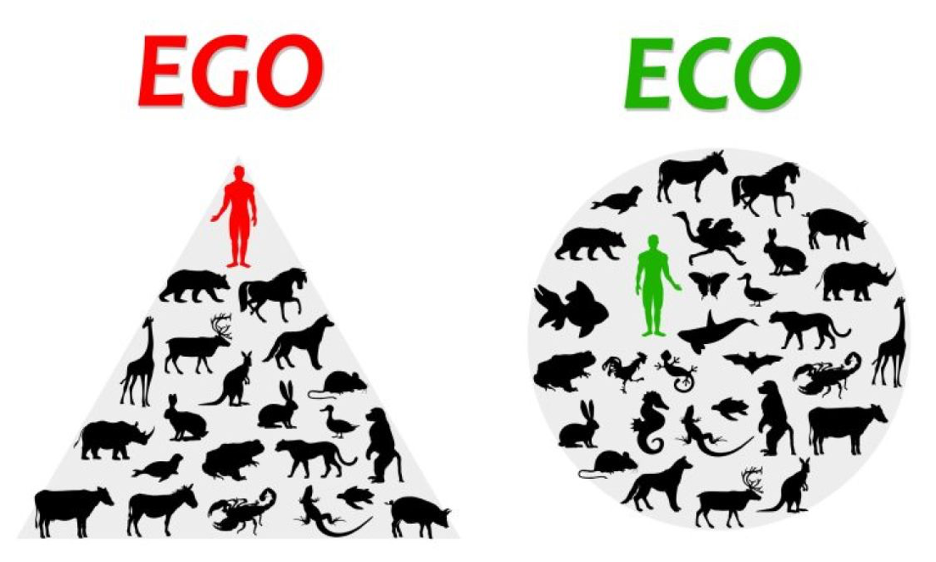
Figure 4. Humans superior to or separate from versus a part of the natural world. (Source: Hans Lak LinkedIn post 11-21-2022)

While the science behind how and how quickly our global ecosystem will change is not precise, the risks could not be higher in dismissing the timing or severity of these changes. While world-class scientists have overwhelming evidence of the impacts and how to mitigate them (United Nations Thailand, 2023, World Economic Forum, 2022, 2023), we cannot become seduced into ignoring or reducing the urgency of arguments on the precision (Bailey, 2023) of what can be done to mitigate the greatest impacts, or outright misinformation and denials (Banerjee et al., 2021). Others, including banks (Kusnetz, 2023), have not sufficiently moved toward a more sustainable built-natural environment. Inadequate action will only increase the risks. There are confounding features of our global environment, such as net growth of Antarctic Sea ice, that has yet to be explained and appears to be acting differently than the Arctic relative to global warming (Blanchard-Wrigglesworth et al., 2022; Antarctica Journal, 2023; NASA Earth Observatory n.d.; Parkinson, 2019). This does not mean that global warming is not real, but it does point out we have a lot to understand.

Planet Earth has one global ecosystem that contains a subordinate human global society and economy. In protecting our planet Earth, re-ordering our human systems to be compatible with nature, and changing hearts and minds, we will succeed or fail—together. (Gergis, 2022; Watts, 2022).

In one final thought, I have recently realized that there is an inextricable link between the existential threats of balancing truly sustainable built-natural environments and of castes in the United States and around the world (Bakewell-Stone, 2021; Wilkerson, 2020)—a planetary crisis. Over the next 20 years, we are going to encounter a “karmic moment of truth” as to how we collectively determine the quality and direction of our world society, built, and natural environments (Isabel Wilkerson interview of 2-13-2023 on The Last Word news broadcast with Lawrence O’Donnell; World Economic Forum, 2023; Vespa, 2020). We must become a real pluralistic society in the United States and globally. Diversity in nature and humanity is the default, not a monoculture. Diversity provides deeper, more flexible, more resilient, and ultimately stronger systems.

In a world without caste, being male or female, light or dark, immigrant or native-born, would have no bearing on what anyone was perceived as being capable of. In a world without caste, we would all be invested in the well-being of others in our species if only for our own survival, and recognize that we are in need of one another more than we have been led to believe. We would join forces with indigenous people around the world raising the alarm as fires rage and glaciers melt. We would see that, when others suffer, the collective human body is set back from the progression of our species. A world without caste would set everyone free.”

Wilkerson, 2020

It is the human species that has fashioned the world in which we live, and the trends we have created. Likewise, our responsibility is to solve our built-natural environment challenges while resolving our caste issues. The United Nations (2023a, 2023b, 2023c), and many others have stoked, advocated, and advanced needed change. Still, “The 2020s will be remembered as the decade that determined the fate of humanity. We can each choose to be part of the critical mass that will change the world. And when we do, it will bring profound meaning and purpose to our lives.” (Lohan, 2023; Gergis, 2023).

Wisdom is knowing that you know nothing.”

—Socrates 399 B.C., from ‘Plato’s Apology’ (my simple interpretation: to have the humility for continuous learning and changing your thinking)

Let’s face it, the universe is messy. It is nonlinear, turbulent, and chaotic. It is dynamic. It spends its time in transient behavior on its way to somewhere else, not in mathematically neat equilibria. It self-organizes and evolves. It creates diversity, not uniformity. That’s what makes the world interesting, that’s what makes it beautiful, and that’s what makes it work.” 

—Donella Meadows

If all mankind were to disappear, the world would regenerate back to the rich state of equilibrium that existed ten thousand years ago. If insects were to vanish, the environment would collapse into chaos.” 

—Edward O. Wilson

Literature Cited

9News. (2023, March 20). World on “thin ice” as UN climate report gives stark warning. Breaking Australian and World News Headlines – 9News. Retrieved April 23, 2023, from https://www.9news.com.au/world/climate-change-ipcc-report-antonio-guterres-says-world-on-thin-ice-as-un-climate-report-gives-stark-warning/fd6c84d9-6139-40a9-a971-866da5233ca1

Antarctica Journal. (2023, April 2). Antarctic Ice Sheet Mass Gains Greater Than Losses. Antarctica Journal. Retrieved May 13, 2023, from https://www.antarcticajournal.com/antarctic-ice-sheet-mass-gains-greater-than-losses/

Bailey, R. (2023, March 21). Is the “Climate Time-Bomb” Really Ticking Toward Imminent Catastrophe? Reason.com. Retrieved April 23, 2023, from https://reason.com/2023/03/21/is-the-climate-time-bomb-really-ticking-toward-imminent-catastrophe/

Bakewell-Stone, Petra. (2021). How can we co-create a better world? Academia Letters. Retrieved April 23, 2023, from https://www.academia.edu/50807789/How_can_we_co_create_a_better_world?email_work_card=thumbnail

Banerjee, N., L. Song, D. Hasemyer. (2021, April 27). Exxon’s Own Research Confirmed Fossil Fuels’ Role in Global Warming Decades Ago – Inside Climate News. Inside Climate News. Retrieved April 23, 2023, from https://insideclimatenews.org/news/16092015/exxons-own-research-confirmed-fossil-fuels-role-in-global-warming/

Bardi, U., & Pereira, C. Á. (2022). Limits and beyond: 50 years on from the limits to growth, what did we learn and what’s next?: A report to the Club of Rome. Exapt Press.

Barrage, L. and W. D. Nordhaus. (2023, April). Policies, Projections, and the Social Cost of Carbon: Results from the DICE-2023 Model. National Bureau of Economic Research. Retrieved April 23, 2023, from https://www.nber.org/system/files/working_papers/w31112/w31112.pdf

Blancard- Wrigglesworth, E., I. Eisenman, S. Zhang, S. Sun, and A. Donohoe. (2022). New perspectives on the Enigma of Expanding Antarctic Sea Ice. The Philadelphia Inquirer. Retrieved May 13, 2023, from https://www.inquirer.com/science/climate/climate-change-report-humanity-emissions-20230320.html

Borenstein, S. and F. Jordans. (2023, March 20). World is on “thin ice” as UN climate report gives stark warning. Climate News. The Philadelphia Inquirer. Retrieved April 23, 2023, from https://www.inquirer.com/science/climate/climate-change-report-humanity-emissions-20230320.html

Bressan, D. (2021, August 10). Online Map Shows How Rising Sea Levels Will Impact Humanity [Audio]. Forbes. Retrieved April 23, 2023, from https://www.forbes.com/sites/davidbressan/2021/08/10/online-map-shows-how-rising-sea-levels-will-impact-humanity/?sh=6ffc4a185a8a

Carew, K. (2023, April 22). Animals Can Save Us – If We Let Them. Time. Retrieved May 13, 2023, from https://time.com/6272815/animals-can-save-us-earth-day/

Cowie, R. H., P. Bouchet, B. Fontaine (2022, January 10). The Sixth Mass Extinction: fact, fiction or speculation?[Video]. Biological Reviews; Wiley. Retrieved April 23, 2023, from https://doi.org/10.1111/brv.12816

Dryden, H., and D. Duncan. (2022, October 28). Climate Disruption Caused by a Decline in Marine Biodiversity and Pollution [Video]. International Journal of Environment and Climate Change; SCIENCEDOMAIN international. https://doi.org/10.9734/ijecc/2022/v12i111392

Freedman, A. (2023, March 24). Tiny island nation takes climate change to The Hague. Axios.  Retrieved April 23, 2023, from https://www.axios.com/2023/03/24/tiny-island-nation-vanuatu-climate-change-hague

Gergis, J. (2022, August 25). Friday essay: “I feel my heart breaking today” – a climate scientist’s path through grief towards hope[Video]. The Conversation. Retrieved April 23, 2023, from https://theconversation.com/friday-essay-i-feel-my-heart-breaking-today-a-climate-scientists-path-through-grief-towards-hope-188589?utm_medium=ampemail&utm_source=email

Gergis, J. (2023). Humanity’s Moment: A Climate Scientist’s Case for Hope. Island Press.

Greenfield, P. (2023, March 2). Overconsumption by the rich must be tackled, says acting UN biodiversity chief. Biodiversity | the Guardian. Retrieved April 23, 2023, from https://amp-theguardian-com.cdn.ampproject.org/c/s/amp.theguardian.com/environment/2023/mar/02/overconsumption-by-rich-must-be-tackled-says-acting-un-biodiversity-chief-aoe

Greshko, M. (2021, May 3). What are mass extinctions, and what causes them? Science. Retrieved April 23, 2023, from https://www.nationalgeographic.com/science/article/mass-extinction

Harvey, F. and D. Carrington. (2022, November 7). World on ‘highway to climate hell’, UN chief warns at Cop27 summit. The Guardian. Retrieved April 23, 2023, from https://www.theguardian.com/environment/2022/nov/07/cop27-climate-summit-un-secretary-general-antonio-guterres

Herrington, G. (2022). Five Insights for Avoiding Global Collapse: What a 50-Year-Old Model of the World Taught Me About a Way Forward for Us Today. Mdpi AG.

Holger, D. (2023, April 5). At Least 10,000 Foreign Companies to Be Hit by EU Sustainability Rules. WSJ. Retrieved April 23, 2023, from https://www.wsj.com/articles/at-least-10-000-foreign-companies-to-be-hit-by-eu-sustainability-rules-307a1406

International Planet Protection Convention. (n.d.). Synthesis Report of the IPCC Sixth Assessment Report (AR6). Summary for Policymakers. IPCC. Retrieved April 23, 2023, from https://report.ipcc.ch/ar6syr/pdf/IPCC_AR6_SYR_SPM.pdf

Jazeera, A. (2022, October 26). UN says countries’ climate plans ‘nowhere near’ 1.5C goal. Climate Crisis News | Al Jazeera. Retrieved April 23, 2023, from  https://www.aljazeera.com/news/2022/10/26/un-says-countries-climate-plans-nowhere-near-1-5c-goal

Jazeera, A. (2023, February 15). UN chief says rising seas a ‘death sentence’ for some countries. Climate Crisis News | Al Jazeera. Retrieved April 23, 2023, from https://www.aljazeera.com/news/2023/2/15/un-chief-says-rising-seas-a-death-sentence-for-some-countries

Khatib, J. (2023, April 22). Cool Transportation Hacks Cities Are Using to Fight Climate Change. Scientific American. Retrieved May 13, 2023, from https://www.scientificamerican.com/article/cool-transportation-hacks-cities-are-using-to-fight-climate-change/

Kusnetz, N. (2023, April 13). Banks Say They’re Acting on Climate, But Continue to Finance Fossil Fuel Expansion. Inside Climate News. Retrieved April 23, 2023, from https://insideclimatenews.org/news/13042023/banks-say-theyre-acting-on-climate-but-continue-to-finance-fossil-fuel-expansion/

Leahy, P. (2023, April 28). President condemns ‘obsession’ with economic growth. The Irish Times. Retrieved May 13, 2023, from https://www.irishtimes.com/politics/2023/04/28/president-condemns-obsession-with-economic-growth/

Lohan, T. (2023, March 20). ‘What Really Keeps Me Up at Night’: A Climate Scientist’s Call to Action. The Revelator. Retrieved April 23, 2023, from https://therevelator.org/gergis-climate-change/

McCoy, M. K. (2023, April 25). Why understanding people is key to protecting nature. Conservation International. Retrieved May 13, 2023, from https://www.conservation.org/blog/why-understanding-people-is-key-to-protecting-nature

McGuigan, M. (2022, August 11). The 6th mass extinction hasn’t begun yet, study claims, but Earth is barreling toward it. LiveScience. Retrieved April 23, 2023, from https://www.livescience.com/sixth-mass-extinction-underway

Meadows, D. H., D. L. Meadows, J. Randers, W. W. Behrens III. (1972). The Limits to Growth: A Report for the Club of Rome’s Project on the Predicament of Mankind. New York: Universe Books.

Meredith, S. (2023, January 2). The world’s in a “polycrisis” — and these countries want to quash it by looking beyond GDP. CNBC. Retrieved April 23, 2023, from https://www-cnbc-com.cdn.ampproject.org/c/s/www.cnbc.com/amp/2022/12/26/well-being-these-countries-are-looking-beyond-gdp-and-economic-growth.html

Miller, D. C., I. R. Scales, and M. B. Mascia (2023). Conservation Social Science: Understanding People, Conserving Biodiversity. John Wiley & Sons.

NASA Earth Observatory. (n.d.). World of Change: Antarctic Sea Ice.  NASA. Retrieved May 13, 2023, from https://earthobservatory.nasa.gov/world-of-change/sea-ice-antarctic

National Academies of Sciences, Engineering, and Medicine. (2022). Next Generation Earth Systems Science at the National Science Foundation. National Academies of Sciences, Engineering, and Medicine. Retrieved April 23, 2023, from https://nap.nationalacademies.org/catalog/26042/next-generation-earth-systems-science-at-the-national-science-foundation

National Academies of Sciences, Engineering, and Medicine. (2023a, April 12). National Academies Launch New Climate Crossroads Initiative. National Academies of Sciences, Engineering, and Medicine. Retrieved April 23, 2023, from https://www.nationalacademies.org/news/2023/004/national-academies-launch-new-climate-crossroads-initiative

National Academies of Sciences, Engineering, and Medicine. (2023b). Integrating Public and Ecosystem Health Systems to Foster Resilience: A Workshop to Identify Research to Bridge the Knowledge-to-Action Gap: Proceedings of a Workshop. The National Academies Press. Retrieved April 23, 2023, from https://doi.org/10.17226/26896

National Oceanic and Atmospheric Administration. (2022a, February 15). U.S. coastline to see up to a foot of sea level rise by 2050. NOAA Climate.gov. Retrieved April 23, 2023, from https://www.noaa.gov/news-release/us-coastline-to-see-up-to-foot-of-sea-level-rise-by-2050

National Oceanic and Atmospheric Administration. (2022b, April 29). Climate Change: Global Sea Level. (2022, April 19). NOAA Climate.gov. Retrieved April 23, 2023, from https://www.climate.gov/news-features/understanding-climate/climate-change-global-sea-level

O’Neill, D.W., Fanning, A.L., Lamb, W.F. et al. (2018). A good life for all within planetary boundaries. Nat Sustain 1, 88–95 (2018). Retrieved May 13, 2023, from https://doi.org/10.1038/s41893-018-0021-4;  https://goodlife.leeds.ac.uk/national-snapshots/countries/#New%20Zealand

Parkinson, C. L. (2019). A 40-y record reveals gradual Antarctic sea ice increases followed by decreases at rates far exceeding the rates seen in the Arctic. Proceedings of the National Academy of Sciences of the United States of America, 116(29), 14414–14423. Retrieved May 13, 2023, from https://doi.org/10.1073/pnas.1906556116

Puko, T. (2023, April 22). EPA plan would impose drastic cuts on power plant emissions by 2040. Washington Post. Retrieved April 23, 2023, from https://www.washingtonpost.com/climate-environment/2023/04/22/epa-power-plant-emissions-climate/

Ramanujan, K. (2021, October 19). More than 99.9% of studies agree: Humans caused climate change. Cornell Chronicle. Retrieved April 23, 2023, from https://news.cornell.edu/stories/2021/10/more-999-studies-agree-humans-caused-climate-change

Reuters. (2023, April 13). Apple to Use Only Recycled Cobalt in Batteries by 2025. U.S. News. Retrieved April 23, 2023, from https://www.usnews.com/news/technology/articles/2023-04-13/apple-to-use-100-recycled-cobalt-in-batteries-by-2025

Rice, D. and D. V. Pulver. (2023, March 20). ‘Humanity is on thin ice:’ Major UN report says ‘urgent’ action is needed to combat climate change. Yahoo!News. Retrieved April 23, 2023, from https://news.yahoo.com/major-un-report-says-urgent-130007251.html

Ripple, W. J., C. Wolf, T. M. Lenton, J. W. Gregg, S. M. Natali, P. B. Duffy, J. Rockström, H. J. Schellnhuber. (2023). Many risky feedback loops amplify the need for climate action. One Earth, 6(2), 86–91. Retrieved April 23, 2023, from https://doi.org/10.1016/j.oneear.2023.01.004

Rotterdam School Or Management, Erasmus University (2020). RMS Discovery 38. Rotterdam School Or Management. Retrieved April 23, 2023, from https://www.rsm.nl/fileadmin/About_RSM/Discovery_magazine/RSM_Disc_38.pdf

Savini, F. (2022, November 7). Post-growth, degrowth, the doughnut and circular economy: a short guide. Save the Planet Amateurs. Retrieved April 30, 2023, from https://planetamateur.com/2022/11/07/post-growth-degrowth-the-doughnut-and-circular-economy-a-short-guide/

Stanway, D. (2023, March 6). Nations secure U.N. global high seas biodiversity pact. Reuters. Retrieved April 30, 2023, from https://www.reuters.com/business/environment/nations-secure-un-global-high-seas-biodiversity-pact-2023-03-05/

Sumata, H., L. D. De Steur, D. V. Divine, M. A. Granskog, and S. Gerland, S. (2023, March 15). Regime shift in Arctic Ocean sea ice thickness. Nature, 615(7952), 443–449. Retrieved April 30, 2023, from https://doi.org/10.1038/s41586-022-05686-x

Sustainability Research Institute. (2023, February). The Why, What, and How of Corporate Biodiversity Action: An Introduction for Manufacturing Companies. Schneider Electric. Retrieved April 23, 2023, from https://download.schneider-electric.com/files?p_Doc_Ref=Corporate_Biodiversity_Action

The Editors. (2023, April 1). Use Nature as Infrastructure. Scientific American. Retrieved May 13, 2023, from https://www.scientificamerican.com/article/use-nature-as-infrastructure

United Nations. (2020, September 19). Take Action for the Sustainable Development Goals – United Nations Sustainable Development. United Nations Sustainable Development. Retrieved April 30, 2024, from https://www.un.org/sustainabledevelopment/sustainable-development-goals/,

United Nations. (n.d.) About Us. UN SDG:Learn. Retrieved April 30, 2023, from https://www.unsdglearn.org/about-us/

United Nations. (2023). Global Sustainable Development Report (GSDR) 2023 | Department of Economic and Social Affairs. (n.d.). Retrieved April 30, 2023, from https://sdgs.un.org/gsdr/gsdr2023

United Nations Thailand. (2023, March 21). A how-to guide to defuse the climate time-bomb. United Nations Thailand. Retrieved April 23, 2023, from https://thailand.un.org/en/224021-how-guide-defuse-climate-time-bomb

U.S. Army Corps of Engineers Headquarters. (n.d.). USACE Engineering With Nature Initiative launches new network, partnership. U.S. Army Corps of Engineers. Retrieved April 30, 2023, from https://www.usace.army.mil/Media/News-Archive/Story-Article-View/Article/2385365/usace-engineering-with-nature-initiative-launches-new-network-partnership/

van der Wijst, KI., F. Bosello, S. Dasgupta, et al. (2023). New damage curves and multimodel analysis suggest lower optimal temperature. Nat. Clim. Chang. Retrieved April 30, 2023, from https://doi.org/10.1038/s41558-023-01636-1

Vespa, J., L. Medina, and D. M. Armstrong. (2020). Demographic Turning Points for the United States: Population Projections for 2020 to 2060. Current Population Reports, P25-1144, U.S. Census Bureau, Washington, DC, 2020.

Watts, J. (2023, March 27). World ‘population bomb’ may never go off as feared, finds study. The Guardian. Retrieved April 23, 2023, from https://www.theguardian.com/world/2023/mar/27/world-population-bomb-may-never-go-off-as-feared-finds-study

We Don’t Have Time. (n.d.). About us. We Don’t Have Time. Retrieved April 30, 2023, from https://www.wedonthavetime.org/about-us

Weise, E. (2023a, January 24). Doomsday Clock 2023 says the world is closer than ever to global catastrophe. USA Today. Retrieved April 30, 2023, from https://www.usatoday.com/in-depth/news/nation/2023/01/24/doomsday-clock-2023-time-announced/11026446002/?build=native-web_i_t

Weise, E. (2023b, April 22). On Earth Day, scientists tell us what 2050 could be like. Their answers might surprise you. USA Today. Retrieved April 30, 2023, from https://www.msn.com/en-us/news/us/on-earth-day-scientists-tell-us-what-2050-could-be-like-their-answers-might-surprise-you/ar-AA1a8Oce

Wilkerson, I. (2020). Caste: The Origins of Our Discontents. Random House.

World Economic Forum. (2022). The Global Risks Report 2022. 17th Edition. World Economic Forum. Retrieved April 20, 2023, from https://www3.weforum.org/docs/WEF_The_Global_Risks_Report_2022.pdf

World Economic Forum. (2023, March 21).World Economic Forum Annual Meeting 2023, Davos. World Economic Forum. Retrieved April 30, 2023, from https://www.weforum.org/events/world-economic-forum-annual-meeting-2023
We will Succeed or Fail—Together: caring for our built-natural environment (Part 2 A Systems Approach and Tenants for a Path Forward: Some Background for Program Management)

02 Sunday Apr 2023

Posted by John L. Craig in Biological Diversity, Built Environment, Business Transformation, Clean Energy, Climate, Collaboration, Communications, Construction, Economics, Economy, Education, Empowering Women, Environment, Environmental Justice, Extinction of Species, Feedback Loops, Future, Governance, Government & Policy, Growth, Homo sapiens, Human Rights, Inequality, Infrastructure, Investing, Leadership, Learning and Success, Natural Environment, Partnerships and Collaboration, Performance Measurement and Management, Planning, Polarization, Poverty, Program Management, Project Management, Recycling, Relationships, Resilience, Results, Risks, Social Justice and Equity, Society, Strategic Planning, Sustainability, Systems Thinking, Tipping Ponts, Transportation, Turn-arounds, Wealth, Well-being

≈ Leave a comment

There are a lot of systems thinkers but two are among my favorites:

  • Edward O. Wilson, a world-renowned scientist of the natural environment (Wilson, 1998, 2012, 2014, 2016, and many others not reflected in this blog)
  • Robert Prieto, a world-renowned engineer of the built environment (Prieto, 2008, 2015, 2017, 2020, 2022a, 2022b, and many others not reflected in this blog)

Another favorite of mine is Donella Meadows’ Thinking in Systems (2008) a sustainability-focused book and one of the original 1972 The limits to Growth authors. Many others are actively addressing the fundamentals of improving our built-natural environment.

There are also other systems thinking efforts toward more holistic thinking underway. It is encouraging to see efforts on valuing nature, such as a recent agreement by the United States and Australia (Chung, 2022)  and others (MacEacheran, 2022; Well Being Economy Alliance, n.d.). Two of the more significant efforts toward more holistic thinking include the National Academies (2022) report with recommendations on taking a systems approach toward a better understanding of the built-natural environment and Gaya Herrington’s (2022) book on five insights from a relook at the original Limits to Growth model which confirmed the original 1972 trend lines. I am especially struck by the latter’s objectivity and clarity. In sum, her five insights are:

  1. We are connected, and acting like we are not has led us to the brink of collapse.
  2. Growth is not a good goal. In fact, it is the cause of society’s problems.
  3. We need to fundamentally change society’s priorities if we want to avoid significant declines in our current levels of well-being.
  4. Time is of the essence to make this change.
  5. The end of the growth pursuit does not mean the end of progress, quite the opposite.

Tenants of a path forward:

I have tried to establish this list of tenants which will be needed to engage the challenges of global growth in a meaningful and productive way.

  1. A good faith effort must be made by all, or at least a majority, to avoid the tipping points, which could last centuries if not millennia (Dixon-Declève et al., 2022).
  2. A clear and straightforward focus must be developed to bring these challenges to the attention of the public. The lack of a clear focus, in fact, may be part of the problem in engaging our global society in an acutely focused direction forward rather than for narrow scientific, engineering, or other interests. This is a very difficult task. The world is now replete with conferences, meetings, books, publications, and other venues on a path forward before it is too late. This collection of venues is so vast it is virtually impossible to stay up with, much less digest.
  3. A clear strategy and planning are needed to substantially manage positive and negative risks. Some are asserted by Dixon-Declève et al. (2022) as follows:
    • Ending poverty
    • Addressing gross inequality (Copley, 2022; Gleick, 2021)
    • Empowering women
    • Making food healthy for people and ecosystems
    • Transitioning to clean energy
  4. A program management approach is needed. A program involves interrelated projects combined with a systems approach. The extra investment required to build a more resilient civilization is estimated at two to four percent of global income per year for sustainable energy and food security alone. These “turnarounds” will surely be disruptive, and the likelihood of occurring is not high (Dixon-Declève, et al., 2022).
  5. Priorities must be made. This will be neither clear nor simple, but I would suggest a good starting point is Herrington’s Figure 32 titled “Finance system within ecosystem, stable versus fragile” (Herrington, 2022). I might suggest calling this figure “Herrington’s Hierarchy of our Planet.” This is no great surprise since we all live within our planet’s natural ecosystem.
  6. Meaningful metrics must be developed. I say meaningful because everything that can be measured is not important, and everything important cannot be easily measured. Recently, NASA space satellites are tracking 50 super emitters around the world (Greicius, 2023; Hartono, 2022).  Some metrics being used are not accurate and therefore misleading and not very meaningful to developing a sustainable built-natural environment (Elgin and Rangarajan, 2022; Boudreau, 2022). This is highly problematic. Still, accurate and meaningful metrics on the health of our natural environment must be weighted equally, or higher, to the built environment on which it depends. They must reflect reality, not wrong, misleading, or inaccurate metrics that only make the task more difficult, if not impossible. This also includes a standard definition and understanding of terms (Jones, 2022; Savini, 2022).
  7. Above all, action must be taken in conjunction with feedback loops to measure progress and enable adjustments to align the way. Without action, it is just a lot of talk. Dixon-Declève et al (2022) provide a pretty common sense list of actions for our future which I have adapted.
    • Reduce polarization.
    • Share wealth more fairly.
    • Act in the interests of future generations.
    • Change how you measure progress, value well-being and nature over financial growth.
    • Engage citizens about what really matters in society…most don’t read papers and books on our planet’s dilemmas.
    • Send unequivocal signals to markets on long-term commitment and investment transformation.
    • Join the movements and do what you can in your own life.
    • Vote for politicians who value the future.
    • Start conversations and efforts in how our global society and planet can be improved.
    • The need for meaningful feedback loops has already been mentioned but bears repeating. These are needed to measure progress and adjust as needed to achieve priorities and goals.
    • Finally, as feedback is received, adjust actions as needed to achieve the stated priorities and goals.

One of the most salient, simple, and summarized rules for a healthy built-natural environment is from Donella Meadows, et al. (1972), and this still speaks true today.

  1. Renewable resources should be used no faster than they can regenerate.
  2. Pollution and wastes shall not be put into the environment faster than the environment can recycle them or render them harmless.
  3. Non-renewable resources shall not be used at all, and renewable substitutes should be developed.
  4. The human population and the physical capital plant must be kept at levels low enough to meet the first three conditions.
  5. The previous four conditions must be met through processes that are democratic and equitable enough that people will stand for them.

In theory, the United Nations seems the right governance body to lead this work. The UN’s work is meaningful to our global society and planetary ecosystem, including 17 ambitious sustainability goals developed in 2015. These goals were targeted to be accomplished by 2030 and some progress has been made (United Nations, 2022, 2023). These goals are:

  1. No poverty
  2. Zero hunger
  3. Good health and well-being
  4. Quality education
  5. Gender equality
  6. Clean water and sanitation
  7. Affordable and clean energy
  8. Decent work and economic growth
  9. Industry innovation and infrastructure
  10. Reduced inequalities
  11. Sustainable cities and communities
  12. Responsible consumption and production
  13. Climate action
  14. Life below water
  15. Life on land
  16. Peace, justice, and strong institutions
  17. Partnerships for the goals

However, the UN (by design) lacks the authority to bring all nations in line with what is needed, and it is a fantasy to believe otherwise (e.g., United Nations, 2022). Thus, it is an open question whether the myriad efforts currently underway will succeed in mitigating the growing impacts on our global society and ecosystem or whether a new form of governance should be developed. Will each country rise to the occasion (Searcey, 2022; Office of Science and Technology Policy, 2022; Greenfield, 2022; Frazen, 2022; Meyer 2022)? Will companies force the needed change (Weston, 2022; Schneider Electric, 2022; World Economic Forum, 2022)? Will we find common ground and work together to resolve our collective issues (Sarkar, 2019)? Will people around the world force and guide us, from the ground up, to a more sustainable built-natural environment (Meadows, 1994; Wahl, 2020)? What is fair and equitable responsibility (for example, Ghosh et al., 2022)? How will the public and private sectors work together in resolving this existential crisis? These are all critical but unanswered questions. As it is, efforts are largely fragmented while many are doing the best they can.

There is a lot of work to be done, individually, societally, and globally. The simple and unavoidable truth is that whatever the future holds, we will succeed or fail together.

There are no separate systems. The world is a continuum. Where to draw a boundary around a system depends on the purpose of the discussion.

—Donella Meadows

Literature Cited

Boudreau, C. (2022, Dec 2). Qatar promised a carbon-neutral World Cup. Climate advocates call that pledge misleading. Business Insider India. Retrieved April 1, 2023, from https://www-businessinsider-in.cdn.ampproject.org/c/s/www.businessinsider.in/international/news/qatar-promised-a-carbon-neutral-world-cup-climate-advocates-call-that-pledge-misleading-/amp_articleshow/95923047.cms

Chung, L. (2022, December 16). US, Australia sign pact to measure environment’s economic value. The Sydney Morning Herald. Retrieved April 1, 2023, from https://www.smh.com.au/environment/sustainability/us-australia-sign-pact-to-measure-environment-s-economic-value-20221215-p5c6lz.html

Copley, M. (2022, November 9). Investors have trillions to fight climate change. Developing nations get little of it. NPR. Retrieved April 1, 2023 from https://www.npr.org/2022/11/09/1134865038/investors-have-trillions-to-fight-climate-change-developing-nations-get-little-o

Dixon-Declève, S., W. Gaffney, J. Ghosh, J. Randers, J. Rockström, P. Espen Stoknes. (2022). Earth for All: a survival guide for humanity, New Society Publishers, Canada.

Electric, S. (2022, October 20). Walmart, Ørsted, and Schneider Electric Announce First Cohort for Renewable Energy Supply Chain Program: Gigaton PPA. Yahoo Finance. https://finance-yahoo-com.cdn.ampproject.org/c/s/finance.yahoo.com/amphtml/news/walmart-rsted-schneider-electric-announce-132000165.html

Elgin, B. & Rangarajan, S. (2022, November 1). What Really Happens When Emissions Vanish? Bloomberg. Retrieved April 2, 2023 from https://www.bloomberg.com/news/features/2022-11-01/intel-p-g-cisco-among-major-companies-exaggerating-climate-progress?utm_campaign=news&utm_medium=bd&utm_source=applenews&leadSource=uverify%20wall

Frazin, R. (2022, November 5). Four issues to watch at the COP27 global climate summit. The Hill. Retrieved April 1, 2023, from https://thehill.com/policy/energy-environment/3720366-four-issues-to-watch-at-the-cop27-global-climate-summit/

Ghosh, J., S. Chakraborty, A. Sucar Diaz Ceballos, A. Ibnat Jamilee Adiba. (2022). A just transition: how can we fairly assign climate responsibility? Earth for All. Retrieved April 1, 2023, from https://www.clubofrome.org/wp-content/uploads/2022/07/Earth4All_Deep_Dive_Ghosh.pdf

Gleick, P. (2021, August 25). The climate crisis will create two classes: those who can flee, and those who cannot. The Guardian. Retrieved April 1, 2023, from https://www.theguardian.com/commentisfree/2021/jul/07/global-heating-climate-crisis-heat-two-classes?CMP=oth_b-aplnews_d-1

Greenfield, P. (2022, November 5). Brazil, Indonesia and DRC in talks to form ‘Opec of rainforests.’ Brazil | the Guardian. Retrieved April 1, 2023, from https://amp-theguardian-com.cdn.ampproject.org/c/s/amp.theguardian.com/environment/2022/nov/05/brazil-indonesia-drc-cop27-conservation-opec-rainforests-aoe

Greicius, T. (2023, February 3). NASA Space Missions Pinpoint Sources of CO2 Emissions on Earth. NASA. Retrieved April 1, 2023, from https://www.nasa.gov/feature/jpl/nasa-space-missions-pinpoint-sources-of-co2-emissions-on-earth

Hartono, N. (2022, October 25). Methane ‘Super-Emitters’ Mapped by NASA’s New Earth Space Mission. NASA.  Retrieved April 1, 2023, from https://www.nasa.gov/feature/jpl/methane-super-emitters-mapped-by-nasa-s-new-earth-space-mission

Herrington, G. (2022). Five Insights for Avoiding Global Collapse: What a 50-Year-Old Model of the World Taught Me About a Way Forward for Us Today. Mdpi AG.

Jones, B. (2022, December 15). World leaders are racing to protect nature – but the definition of one word is tripping them up. Vox. Retrieved April 1, 2023, from https://www.vox.com/down-to-earth/2022/12/15/23508857/cop15-biodiversity-montreal-conservation-protected-areas

MacEacheran, M. (2022, November 1). Scotland could become first ‘rewilded’ nation—what does that mean? Travel. Retrieved April 1, 2023, from https://www.nationalgeographic.com/travel/article/scotland-could-become-first-rewilded-nation-what-does-that-mean

Meadows, D. H., D. L. Meadows, J. Randers, and W. W. Behrens III. (1972). The Limits to Growth: A Report for the Club of Rome’s Project on the Predicament of Mankind. New York: Universe Books.

Meadows, D. H. (1994). Envisioning a Sustainable World. Third Biennial Meeting of the International Society for Ecological Economics. Retrieved April 1, 2023, from http://people.whitman.edu/~weilercs/biocomplexity/Meadows.pdf

Meadows, D. H. (2008). Thinking in Systems: A Primer. Chelsea Green Publishing.

Meyer, R. (2022, October 6). The Climate Economy Is About to Explode. The Atlantic. Retrieved April 1, 2023, from https://www.theatlantic.com/science/archive/2022/10/inflation-reduction-act-climate-economy/671659/

National Academies of Sciences, Engineering, and Medicine. (2022). Next Generation Earth Systems Science at the National Science Foundation. The National Academies Press. Retrieved April 1, 2023, from https://nap.nationalacademies.org/catalog/26042/next-generation-earth-systems-science-at-the-national-science-foundation

Office of Science and Technology Policy. (2022, October 31). Framing the National Nature Assessment. Federal Register. Retrieved April 1, 2023, from https://www.federalregister.gov/documents/2022/10/31/2022-23593/framing-the-national-nature-assessment

Prieto, R. (2008). Strategic Program Management. Construction Management Association of America.

Prieto, R. (2015). Resilience: An Engineering & Construction Perspective. Lulu.com.

Prieto, R. (2017). Complexity in Large Engineering & Construction Programs. PM World Journal VI: XI. Retrieved April 1, 2023, from https://pmworldlibrary.net/wp-content/uploads/2017/11/pmwj64-Nov2017-Prieto-complexity-in-large-engineering-construction-programs.pdf

Prieto, R. (2020). Strategic Program Management: Key to “giga” Program Delivery. PM World Journal. IX: IX. Retrieved April 1, 2023, from https://pmworldlibrary.net/wp-content/uploads/2020/08/pmwj97-Sep2020-Prieto-strategic-program-management-key-to-giga-program-delivery-2nd-ed.pdf

Prieto, R. (2022a, September 12). Sustainability Utilizing a Program Management Approach. National Academy of Construction Executive Insights. Retrieved April 1, 2023, from https://www.naocon.org/wp-content/uploads/Sustainability-Utilizing-a-Program-Management-Approach.pdf

Prieto, R. (2022b, September 13). Climate Change – The Role of Program and Project Managers. ResearchGate. Retrieved April 1, 2023, from https://www.researchgate.net/publication/363752757

Sakar, C. (2019, November 12). The Ecosystem of Wicked Problems by Christian Sarkar. Global Peter Drucker Forum BLOG. Retrieved April 1, 2023, from https://www.druckerforum.org/blog/the-ecosystem-of-wicked-problems-by-christian-sarkar/

Savini, F. (2022, November 7). Post-growth, degrowth, the doughnut and circular economy: a short guide. Save the Planet Amateurs. Retrieved April 1, 2023, from https://planetamateur.com/2022/11/07/post-growth-degrowth-the-doughnut-and-circular-economy-a-short-guide/

Searcey, D., & Bashizi, A. (2022, November 10). Can a Nation Replace Its Oil Wealth With Trees? The New York Times. Retrieved April 1, 2023, from https://www-nytimes-com.cdn.ampproject.org/c/s/www.nytimes.com/2022/11/03/climate/gabon-logging-oil-economy.amp.html

United Nations. (2020, September 19). Take Action for the Sustainable Development Goals – United Nations Sustainable Development. United Nations Sustainable Development. Retrieved April 1, 2023, from https://www.un.org/sustainabledevelopment/sustainable-development-goals/

United Nations. (2022, October 26). Climate Plans Remain Insufficient: More Ambitious Action Needed Now. United Nations Climate Change. Retrieved April 1, 2023, from https://unfccc.int/news/climate-plans-remain-insufficient-more-ambitious-action-needed-now

United Nations. (2023). Global Sustainable Development Report. United Nations Department of Economic and Social Affairs Sustainable Development. Retrieved April 1, 2023, from https://sdgs.un.org/gsdr/gsdr2023

Wahl, D. C. (2020, February 12). Learning the art of communing. Age of Awareness – Medium. Retrieved April 1, 2023, from https://medium.com/age-of-awareness/learning-the-art-of-commoning-db7299470f49

Wellbeing Economy Alliance. (n.d.). For an Economy in Service. Wellbeing Economy Alliance. Retrieved April 1, 2023, from https://weall.org/

Weston, P. (2022, December 4). Businesses call for nature impact disclosures to be mandatory by 2030. Biodiversity | the Guardian. Retrieved April 1, 2023, from https://amp-theguardian-com.cdn.ampproject.org/c/s/amp.theguardian.com/environment/2022/oct/26/mandatory-disclosure-impact-nature-2030-cop15-aoe

Wilson, E. O. (1998). Consilience: the unity of knowledge. Alfred A. Knopf.

Wilson, E. O. (2012). The Social Conquest of Earth. W. W. Norton & Company.

Wilson, E. O. (2014). The Meaning of Human Existence. W. W. Norton & Company.

Wilson, E. O. (2016). Half-Earth: Our Planet’s Fight for Life. W. W. Norton & Company.

World Economic Forum. (2022, November 4). More than 100 CEOs and senior executives share an open letter for world leaders at COP27. World Economic Forum. Retrieved April 1, 2023, from https://www.weforum.org/agenda/2022/11/cop27-alliance-of-ceo-climate-leaders

The Mobility Ecosystem: the changing landscape and the need for fresh, new ideas (Part 7: Maximizing Results with Limited Funding)

20 Saturday Feb 2021

Posted by John L. Craig in Alternative Delivery, Asset & Life Cycle Management, Benefit-Cost or BC, Construction, Design, Design Exceptions, Practical Design, Least-Cost Planning, Funding, Intelligent Transportation Systems or ITS, Internet of Things or IoT, Maintenance, Materials, Multimodal Needs Assessment, Needs Assessments, Operations, Partnerships and Collaboration, Performance Measurement and Management, Planning, Program Management, Program or Project Controls, Project Management, Recycling, Relationships, Return on Investment or ROI, Risks, Safety, Scope, Schedule, Budget, Transportation

≈ Leave a comment

There is never enough funding in any organization to meet the needs, much less the wants. The debates to determine funding and how to allocate it are endless and continue to this day at all levels of government (Ryan, 2021). Typically, the effective use of available funding falls to public sector transportation professionals, unless private-sector owners, in conjunction with private sector partners. Thus, it is important to review some analytic tools, methodologies, and aspects for maximizing results with limited funding. These could loosely be considered part of asset management. A more thorough review of asset management, setting a basis, criteria, and priorities, is on the March 6, 2016, article on this website entitled Transportation Asset Management. This discussion merely augments that discussion and is by no means an exhaustive list. In no particular order, these are some of the more important tools, methodologies, and aspects that can help establish priorities and maximize results with limited funding.

  • Asset Management: Every public and private body is under increasing pressure to justify investment and that it is making the best use of its resources. The essence of asset management is to better prioritize resources to optimize outcomes, basically institutionalizing a business-like approach to managing infrastructure—asset management. The ability to retain, retrieve, and analyze increasing amounts of data in recent decades has enabled evidence-based decision-making on a network scale. Made possible by computers and digital technology, other “big picture” analyses are increasingly emerging to include the discipline of sustainability that facilitates decision-making among economic, social, and environmental realms. Performance metrics also began to evolve at the same time as asset management. The result is a fundamental framework for managing resources or assets:
    • Performance measures: what target is desired and achievable
    • Asset:
      • Inventory
      • Condition
      • Utilization
      • Value in dollars
    • Life-cycle cost prediction: estimate remaining useful life
    • Agency or organization cost
    • User cost
    • Trade-off analysis and investment strategies (by combining the above to produce an optimized budget)—criteria to develop needs priorities
    • Develop an emergency fund for unexpected events
    • Develop program including asset needs priorities with available funding

      Asset management is quite literally the best of continuous improvement. That process never ends. More discussion can be found on this website under transportation asset management.
  • Scope, Schedule, Budget: This is closely related to Planning, design, below. Regardless, as a program or project is contemplated, a preliminary and final scope, schedule, and budget must be developed. Tied to the next bullet point, it is common for scope to creep or an ill-defined scope to create problems later on. As such, that can lead to schedule and budget problems later. This is especially prevalent in mega and giga programs and projects. The takeaway: spend the time necessary up front to conduct thorough due diligence, planning, risk assessment, and scoping. It is a lot better and a lot less expensive in time, money, and resources to do it right the first time vice the second or more times. Effective and efficient program or project controls are essential to track changes against the baseline contract of scope, schedule, and budget.
  • Planning, Design: There is no substitute for good, solid planning and design. This in no way discounts good construction, maintenance, operations, materials, and other practices. These can all save or optimize dollars when done right. However, many times problems and opportunities missed can be traced back to the beginning of planning and design. It can be a challenge and take time to get input and reviews from construction, maintenance, operations, stakeholders, and partners. It is worth the effort to do things right or as well as possible at the beginning. Otherwise, time and money will be expended later and opportunities will likely be lost. More broadly, open-source engineering can be more valuable economically and in terms of building on standard design specifications. Thus providing more cost-effective projects, more innovation, improved quality, and scalability. (Shepherd-Smith, 2021).
  • Needs Assessments, Criteria, and Priorities: This may appear obvious, and as stated above it is discussed in more detail in other blogs. Regardless, this process is essential in setting priorities for what to do first, second, third, and so on in spending on the highest priorities. While many governments do this, all do not. The larger, more capable governments tend to do this a lot more than smaller governmental, typically more rural, cities and counties. This typically manifests itself in state departments of transportation doing thorough needs assessments while smaller, less populated cities and counties have neither the staff or funding to do this. This can be a problem. This can be similar in non-highway modes. One solution is to generate one multimodal needs assessment for states, cities, and counties. To gain consensus on such a mechanism would be Herculean but not impossible. As it is, each entity has its own way of identifying needs and setting priorities and the challenge increases as governments establish “formulas” in an attempt to equitably distribute funding to the highest needs. This manifests itself in several ways such as donor and donee states relative to the federal Highway Trust Fund, earmarks depending on the power of elected officials, competitive grants which typically leave out smaller, more rural communities, and others. These are all an attempt to do the best we can but they also fall short. The net result—the inability to fund the highest needs. While it is true that federal and state highways carry the vast majority of traffic, the needs of rural communities are of equal importance. So, the idea of a multimodal and multigovernmental needs assessment should be aspired to if not accomplished. There are some rare examples of similar efforts in other areas that have been successful such as the State of Iowa developing one common state-city-county design manual. Also, the State of Nebraska requires an annual needs assessment (with inventory, standard criteria, inspections, estimated scope and cost, etc) for their state highway system so that the state legislature has a target to determine funding. Uniquely, Nebraska law has a variable fuel tax that adjusts the state fuel tax to meet that funding, regardless of impacts such as decreased fuel consumption due to pandemics or other unforeseen events. A system that effectively prioritizes limited funding to address the needs of one seamless transportation/mobility system would be invaluable to our society vice each governmental entity struggling on its own. While this may never be achieved, it is worth aspiring to.
  • Design Exceptions, Practical Design, and Least-cost Planning: Until perhaps the last two decades, the standards for planning and design were fairly rigidly followed, partly due to liability risks of not doing so. That is understandable because of the importance of standards. However, as funding continues to be tight as needs grow, exceptions have increasingly been made. This evolution began as design exceptions to established standards, to somewhat broader exceptions termed practical design, and that has evolved into more recently termed least-cost planning. The core purpose of all is to maximize results with limited funding where a high proportion of benefits can be gained while accepting little or no additional risk. These are of course highly scrutinized for approval but can save considerable dollars. One mega program in Oregon had 275 design exceptions which saved $683 million.
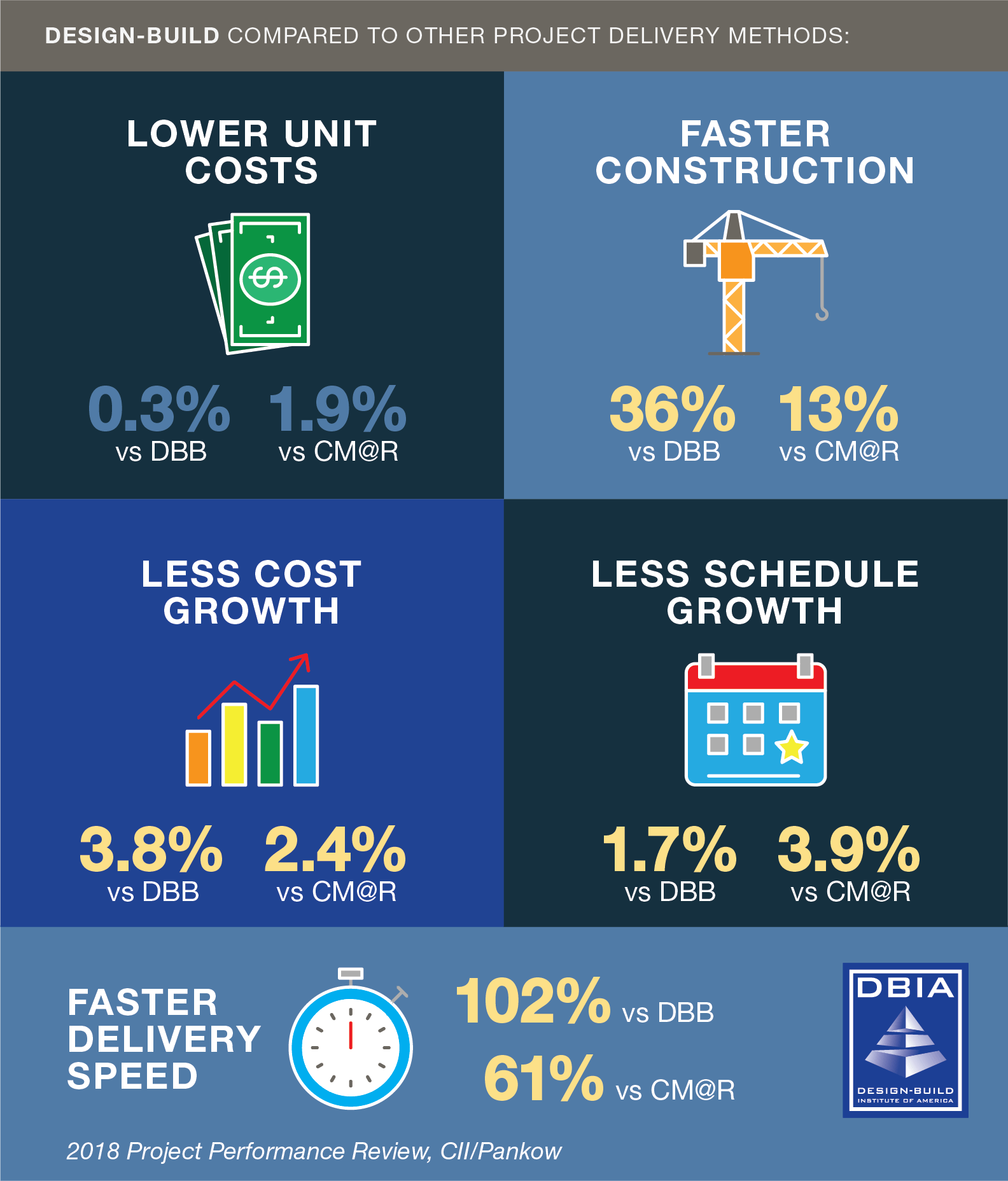
  • Alternative Delivery Methodologies: Alternative delivery methodologies have been around for decades in the form of contracts of which the U. S. Army Corps of Engineers has been one of the more innovative. In 1993 the Design-Build Institute of America (DBIA) agreed upon the term design-build and its use among transportation agencies began to accelerate. Originally established to save time, not money, design-build projects have evolved to save time and money (Figure 8). Other integrated delivery methodologies have also begun to emerge such as design-build-operate, design-build-operate-maintain, construction management-general contractor, public-private-partnerships, and others, each designed for a specific purpose in saving the owner time, money, level of oversight, or all three. The key is that integrated delivery teams can work together, resulting in time and money savings for the owner. Embedded is risk and who has it, but that’s another subject that warrants a paper on its own.
FIGURE 8. Design-build compared to other project delivery methods. Source: DBIA, n.d.
  • Materials: This may seem out of place but it is not. High-strength steel is a good example of allowing wider gaps to be spanned with fewer vertical supports and girders. Superpave asphalt mixes compete effectively with concrete depending on the costs of oil, cement, and other commodities. Likewise, steel can compete against concrete and accrue savings. Fiberglass reinforced-polymer girders and other corrosion-resistant features have also been employed to extend the design life of bridges to at least 100 years (Knapschaefer, 2021). 3D printed bridges and other structures can save on time and labor (U.S. Bridge, 2021).
  • Recycling: Recycling is about saving resources and money. Asphalt, concrete, and steel are regularly recycled by owners and construction contractors, through both on-site and off-site processes. Depending on the strength, bridge girders are utilized on other bridges as appropriate. Old rail cars have been recycled as low cost-culverts where appropriate. One of the more innovative recycling methods being studied is to use old wind turbine blades in bridges as well as buildings, etc., rather than placing them in landfills (Stone, 2021).
  • Engineering Economics: This tool has been around for over 100 years but continues to be relevant although other tools now supplement it and can lead to other conclusions.
  • Life Cycle Costs: This tool has been around for over 100 years although it has been refined during that time. As our perspectives have increasingly become long-term versus short-term or a human lifetime, the life cycle of infrastructure, vehicles, and other assets have taken on additional meaning relative to least-cost decision-making. Therefore, the life cycle cost of any asset is critical to know.
  • Return on Investment (ROI): Commonly known as ROI, this is another analytical tool that can have myriad perspectives. That is the ROI in economic terms, jobs created or sustained, environmental values, social values, and so forth. Regardless, knowing the return on dollars expended is a critical part of decision-making.
  • Benefit-Cost (BC): Benefit-Cost is commonly assessed as a ratio, normally calculated in dollars. Frequently shown as an equation such as a BC ratio of 3:1 or B/C and if the numerator or B is greater than the denominator, then it is concluded to be a benefit. If the numerator or B is less than 1 it is considered a net cost and not a benefit. Nonetheless, this is another important tool in determining investments.
  • Economies of Scale: This is a methodology that can provide a return on scale. For example, “bundling” projects within a region can reduce mobilization and material delivery costs. Conversely, breaking projects up has the potential to increase competition and reduce costs. While this is not a new concept, it is valuable. The term “bundle” is a relatively new term and is now commonly used. Previously, other terms such as “tied projects” were used to describe the same methodology. Buying materials, equipment, and other assets at scale can also provide economies of scale and reduce costs.
  • Multimodal Needs Assessments: Typically, needs assessments have been done by asset or mode with critically important and useful outcomes. As mobility has become increasingly multimodal, the question has become how to conduct needs assessments across all modes. Multimodal planning is common but multimodal needs assessments are largely qualitative, not standardized, and not widely accepted. One of the outcomes in the absence of good, repeatable, and reliable multimodal needs assessments is that funding (federal and state) is distributed based on modal assessments, dominated by highways and bridges, and then a somewhat subjective assessment of how to distribute dollars to each mode. Until we achieve a truly standardized multimodal needs assessment with specific criteria, allocating funds to other modes (such as transit and pedestrians) will be a challenge. Generally, transportation is not a particularly partisan topic at governmental levels, partly because it provides objective information to help determine what funds can or will be appropriated and what the long-term implications may be. This is critical for the built environment in which we live.
  • Operations and Intelligent Transportation Systems (ITS): ITS was one outcome of advancing digital technology. What this allowed was the transportation system to be instrumented with sensors that provide data and information, especially on volume and speed, to a central office that can more quickly and effectively assess and respond to congestion and issues stemming from traffic congestion, crashes, and other incidences. Advanced Traffic Management System (ATMS) is used for traffic management and control and accounts for the most revenue in the overall ITS market. Although the benefit-costs of ITS vary widely from 2-9:1, others exceed 100:1. One ratio used for comparing ITS to more infrastructure is 8:1, a methodology to get more capacity from the existing roadway. The prudent use of ITS technologies can achieve greater benefit at less cost than more concrete, asphalt, and steel. Related, vehicle pricing systems such as electronic toll collection, congestion pricing, vehicle miles traveled, and other road user charging systems can be cost-effective. In addition, transport and supply chain service providers are seeking cost-effective solutions that ITS can provide to boost their productivity, performance, and profits. On e example developed early in Nebraska was a statewide oversize-overweight permitting system that allowed truckers to efficiently route their trucks and cargo and became an effective decision-making tool.
  • Internet of Things or IoT: There are benefits to be gained throughout society by leveraging IoT, including in government, and new opportunities are continually being uncovered to improve services and efficiencies (Center for Digital Government, 2019; AT&T, n.d.; ServiceNow, n.d.; Descant, 2019).
  • Partnerships and Collaboration: It is virtually impossible for any organization to have all the talent, tools, and resources to optimize returns for society, the economy, and our environment. As such, partnerships and collaboration are keys to leveraging the unique strengths of an organization. This is not a new concept, but like the exponential growth of our 4th Industrial or Digital Age, the need is greater than ever before. These strategies continue to grow (Salesforce, n.d.).
  • Program and Project Management: Good program and project management begins and ends with good leadership. The team is all-important since they are the ones that get work done. As such, good leadership can make a team better while bad leadership can destroy a team. This easily translates to improved or decreased performance, costs, and profits. This topic is also discussed in other blogs on leadership, program, and project management on this website. There are many articles and books on program and project management, one of the most prolific and best is Robert Prieto who publishes regularly in PM World. He also authored one of the most comprehensive books on the subject, “Theory of management of large complex projects” (Prieto, 2015). Also, review PMWorld Journal, https://pmworldjournal.com/welcome, and the Project Management Institute (https://www.pmi.org).
  • Risk Management: This is the identification, evaluation, and prioritization of risks followed by methodologies to minimize, monitor, and control the probability or impact of unfortunate events or to maximize the realization of opportunities. The U. S. transportation industry has enormous risk exposure and among the most risk-prone industries in the world. As such, the federal transportation law—Moving Ahead for Progress in the 21st Century Act, or MAP-21, and signed into law in 2012 (FMCSA, n.d.)—established the requirement for states to develop a risk-based asset management plan. Risk management is a dynamic process and used routinely within the public and private sectors. Without such plans, organizations can be surprised by events with negative financial impact or miss positive opportunities with improved outcomes. The literature on risk management is rich and continues to evolve.
  • Strong Relationships: This is another topic that might seem odd within a discussion of maximizing results with limited funding. However, the adage “a good relationship can make a bad contract better while a bad relationship can make a good contract worse” reflects the importance of strong relationships. It is common to have disputes but resolving them in a fair and amicable way while preserving the all-important relationships is critical. No one really wins when disputes move to litigation. This topic is further discussed in other blogs on this website, including the importance of trust.
  • Safety: This may seem an odd topic within the topic of maximizing results with limited funding but the cost in lives, injuries, and property damage is staggering. As has been stated, virtually every transportation organization has the safety of their employees and traveling public as their highest priority. One of these efforts to improve safety, although for NASCAR racing, has important implications for the traveling public (Midwest Roadside Safety Facility, n.d.; Wikipedia, 2021). The work towards a safer built environment will likely never end.

This is by no means meant to be an exhaustive list and is only intended as a sample. The search to reduce costs is part of continuous improvement and that never ends. There are some very simple changes that cumulatively can have huge impacts including the use of LED bulbs in traffic signals and buildings, the use of highly reflective tape rather than electric lit signs, shutting off computers during overnight hours, and so on. This, again, is in no way a substitute for sound and skilled planning, project development, design, construction, maintenance, and operations, all of which continue to evolve and improve within their own discipline.

The Biden Administration recently announced through their Infrastructure for Rebuilding America grants or INFRA some of the above tools and methods as part of their criteria in addition to other related criteria such as climate change, environmental justice, and racial equity (Ichniowski, 2021). Still, other technologies are being advanced with their own inherent efficiencies (New Hampshire Union Leader, 2021; VIA, n.d.; LeBeau, 2021; Danko, 2021; Ewoldsen, 2021). Other technologies that may seem a bit far-fetched continue to advance and may be part of a transportation future and at less cost (Levy, 2021; Subin, 2021; Halvorson, 2021). Still, other areas are advancing, including space, and may well have cost-effective impacts on our futures on earth (Adams, 2021; Hughes, 2020).

Citations

Adams, R. D. (2021, January 21). AI spacefarers and cosmic testbeds: robust robotic systems forge path for human space exploration. TechRepublic. Retrieved February 20, 2021, from https://www.techrepublic.com/article/ai-spacefarers-and-cosmic-testbeds-robust-robotic-systems-forge-path-for-human-space-exploration

AT&T (n.d.) Creating Better Communities. Government Technology. Retrieved February 20, 2021, from https://media.erepublic.com/document/GT18_HANDBOOK_ATT_Slides_V.pdf

Center for Digital Government. (2019). IoT innovation: how government is uncovering new opportunities. Center for Digital Government sponsored by Cisco. Retrieved February 20, 2021, from https://media.erepublic.com/document/CDG18_WHITE_PAPER_Cisco-IoT-NewOps_V.pdf

Danko, P. (2021, February 3). Arcimoto’s latest stock surge gives it $1B market cap. Portland Business Journal. Retrieved February 20, 2021, from https://www-bizjournals-com.cdn.ampproject.org/c/s/www.bizjournals.com/portland/news/2021/02/03/arcimotos-market-cap-1b.amp.html

DBIA. (n.d.). Why choose design-build? Design-Build Institute of America. Retrieved February 20, 2021, from https://dbia.org/what-is-design-build/

Descant, S. (2019, October 29). Chicago collaboration looks to redefine modern transportation. Government Technology. Retrieved February 20, 2021, from https://www.govtech.com/transportation/Chicago-Collaboration-Looks-to-Redefine-Modern-Transportation.html

Ewoldsen, B. (2021, January 21). New mobility services combined with transit show potential to further accessibility, efficiency, equity, safety, and sustainability. Transportation Research Board. Retrieved February 20, 2021, from http://www.trb.org/main/blurbs/181729.aspx

FMCSA. (n.d.). MAP-21 – moving ahead for progress in the 21st century act. Federal Motor Carrier Safety Administration. Retrieved February 20, 2021, from https://www.fmcsa.dot.gov/mission/policy/map-21-moving-ahead-progress-21st-century-act

Halvorson, B. (2021, February 15). Toyota claims the 2021 Mirai fuel-cell car cleans the air, calls it “minus emissions.” Green Car Reports. Retrieved February 20, 2021, from https://www.greencarreports.com/news/1131268_toyota-claims-the-2021-mirai-fuel-cell-car-cleans-the-air-calls-it-minus-emissions

Hughes, O. (2020, November 25). To the moon and beyond: the robots that are blazing a trail for human space exploration. TechRepublic. Retrieved February 20, 2021, from https://www.techrepublic.com/article/to-the-moon-and-beyond-the-robots-that-are-blazing-a-trail-for-human-space-exploration

Ichniowski, T. (2021, February 17). Biden administration adds new climate objective for INFRA grants. Engineering News-Record. Retrieved February 20, 2021, from https://www.enr.com/articles/51239-biden-administration-adds-new-climate-objective-for-infra-grants

Knapschaefer, J. (2021, January 25). Novel fiberglass birders extend life of Maine bridge. Engineering News-Record. Retrieved February 20, 2021, from https://www.enr.com/articles/51086-novel-fiberglass-girders-extend-life-of-maine-bridge

LeBeau, P. (2021, February 10). United Airlines orders electric vertical aircraft, invests in urban air mobility SPAC. CNBC Evolve. Retrieved February 20, 2021, from https://www.cnbc.com/2021/02/10/united-airlines-orders-electric-vertical-aircraft-invests-in-urban-air-mobility-spac.html

Levy, M.G. (2021, February 12). Researchers levitated a small tray using nothing but light. Wired. Retrieved February 20, 2021, from https://www.wired.com/story/researchers-levitated-a-small-tray-using-nothing-but-light/

Midwest Roadside Safety Facility. (n.d.). The safer barrier. University of Nebraska-Lincoln. Retrieved February 20, 2021, from https://mwrsf.unl.edu/saferBarrier.php

New Hampshire Union Leader. (2021, February 15). State-of-the-art traffic signals installed at 17 Dover intersections. New Hampshire Union Leader. Retrieved February 20, 2021, from https://www.unionleader.com/news/safety/state-of-the-art-traffic-signals-installed-at-17-dover-intersections/article_672c26f7-cfcb-5ea2-bd9f-befb1a46d840.html

Prieto, R. (2015). Theory of management of large complex projects. Construction Management Association of America. Retrieved February 20, 2021, from https://www.researchgate.net/publication/299980338_Theory_of_Management_of_Large_Complex_Projects

Salesforce. (n.d.). Accelerating government innovation through collaboration. Salesforce. Retrieved February 20, 2021, from https://media.erepublic.com/document/GOV19_BRIEF_Salesforce_01_V.pdf

ServiceNow. (n.d.). Redefining service delivery for citizens: best practices and a checklist for success. ServiceNow. Retrieved February 20, 2021, from https://media.erepublic.com/document/ebook-government-modernizing-csm.pdf

Shepherd-Smith, P. (2021, February 10). Open source engineering has a role to play in digital transformation. New Civil Engineer. Retrieved February 20, 2021, from https://www.newcivilengineer.com/opinion/open-source-engineering-has-a-role-to-play-in-digital-transformation-10-02-2021/

Stone, M. (2021, January 8). Today’s wind turbine blades could become tomorrow’s bridges. Grist. Retrieved February 20, 2021, from https://grist.org/energy/todays-wind-turbine-blades-could-become-tomorrows-bridges/

Subin, S. (2021, February 14). Why one big Wall Street banker is betting flying taxis will replace helicopters. CNBC Evolve. Retrieved February 20, 2021, from https://www.cnbc.com/2021/02/14/why-wall-street-banker-thinks-flying-taxis-will-replace-helicopters.html

Thomas, R. (2021, January 29). Lawmakers offer competing priorities for infrastructure plans. The Hill. Retrieved February 20, 2021, from https://thehill.com/policy/transportation/infrastructure/536595-lawmakers-offer-competing-priorities-for-infrastructure

U.S. Bridge. (2020, March 24). The future of 3D printed bridges and construction. U.S. Bridge. Retrieved February 20, 2021, from https://usbridge.com/the-future-of-3d-printed-bridges-and-construction/

VIA. (n.d.). Reimagining how the world moves. VIA. Retrieved February 20, 2021, from https://ridewithvia.com/?utm_source=pardot&utm_medium=email&utm_campaign=newsletter_february_2021

Wikipedia. (2021, January 24). Safer barrier. Wikipedia. Retrieved February 20, 2021, from https://en.wikipedia.org/wiki/SAFER_barrier

Management – Getting Results

11 Friday Sep 2015

Posted by John L. Craig in Government & Policy, Management, Performance Measurement and Management

≈ Leave a comment

As part of my leadership philosophy, I separate the leadership of people from the management of things. Inherently people cannot be managed, and in fact resist it. However, they can be led with clear goals, direction, and working toward something that highly motivates them and that is greater than themselves.

That said, the management of things is essential.

First and foremost, a mission statement must be clearly established. That is the ultimate aim. For a Department of Transportation (DOT) and depending on their responsibilities, it is generally accurate to say that they “provide a safe, reliable and sustainable transportation system for the movement of people and goods while improving the economy, mobility and environment.”

Based on my experience, I believe a DOT must establish a relatively small list (10-15) of specific and measurable goals (performance measures) that should be divided into two groups:

  1. strategic goals or outcomes (6-8) and
  2. enablers (7-9) that support the achieving of those goals.

It is fairly common to measure too many goals in a DOT. The risk is losing focus on organizational outcomes, especially at the senior executive level. At the senior executive level it is as important to know what to ignore as it is what to focus on. It is important to measure things and at the right organizational level, especially when issues must be drilled into to reveal areas for improvement. Evidence-based decision-making must take place making true the adage that “the data will set you free”. Nearly everyone has a different opinion of what is important, especially if it is the work they are doing. Everyone’s work should be important and support organizational outcomes. However, these goals must be vetted and the organization aligned to achieve these outcomes. There are essentially seven strategic goals/outcomes for DOTs:

  • safety
  • jobs and commerce
  • mobility
  • access
  • environmental stewardship
  • infrastructure preservation
  • customer service/satisfaction

While I have not defined these, there could be subsets, for example for customer service/satisfaction. Customers can be defined as the public but also legislatures, congress and various partners such as construction contractors, consultants, truckers, shippers etc. I mention this because in the end it is the satisfaction of the customers, supported by the partners, that makes funding, political support, collaboration and a lot of other things work.

Kanter (2015) has a similar idea for a win-win-win-win-win:

  • save lives
  • save costs
  • add convenience by easing congestion
  • reduce pollution and mitigate climate change
  • create future growth opportunities that create new jobs

Another example of outcomes, specific to giga-programs such as the Oregon Transportation Act (OTIA) III State Bridge Delivery Program, is to:

  • stimulate Oregon’s economy
  • employ efficient cost-effective delivery practices
  • maintain freight mobility and keep traffic moving
  • build projects sensitive to their communities and landscape
  • capitalize on funding opportunities

Enablers are largely responsible for:

  • project delivery
  • asset management
  • fiscal responsibility/ROI
  • collaboration/partnership
  • workforce development
  • leveraging technology (think digital technology – transforming transportation and the subject of a later blog)
  • risk management

That said, everything is in a constant process of improvement and so it must be for DOTs and the industry to remain competitive.

One of the more intriguing sources I have come across on the subject of people versus goals/results is from the Harvard Business Review, December 27, 2013, entitled “Should leaders focus on results, or on people?” by Matthew Lieberman. His article reports that if a leader has great social skills only 12% of people consider him a great leader. If a leader has great results skills he is considered great by 14% of people. If a leader has both skill sets the percentage of people rating him a great leader skyrockets to 78%. However, less than 1% of leaders are rated high in both goal focus and social skills.

More will be written in future blogs about the dynamics of people-based, results-driven leadership.

“Management is doing things right; leadership is doing the right things.”

– Peter F. Drucker

Kanter, Rosabeth Moss. Move: Putting America’s Infrastructure Back in the Lead. W. W. Norton & Company, 2015. Print.

Recent Posts

  • We Will Succeed or Fail—Together: caring for our built-natural environment (Part 4 Epilogue)
  • We Will Succeed or Fail—Together: caring for our built-natural environment (Part 3 The Future: Some Background for Program Management)
  • We will Succeed or Fail—Together: caring for our built-natural environment (Part 2 A Systems Approach and Tenants for a Path Forward: Some Background for Program Management)
  • We will Succeed or Fail—Together: caring for our built-natural environment (Part 1 Setting the Stage: Some background for Program Management)
  • Program and Project Management: Three Questions

Recent Comments

Winnie's avatarWinnie on One Seamless Transportation Sy…
laneauxnaijah1990's avatarlaneauxnaijah1990 on We Will Succeed or Fail—Togeth…
Leonard's avatarLeonard on The Mobility Ecosystem: the ch…
Nora Black's avatarNora Black on Leadership: People Skills and…
jseprogrammanagement's avatarjseprogrammanagement on Program and Project Management…

Archives

  • June 2023
  • May 2023
  • April 2023
  • March 2023
  • October 2022
  • June 2021
  • April 2021
  • March 2021
  • February 2021
  • January 2021
  • May 2019
  • April 2019
  • December 2018
  • October 2017
  • September 2016
  • March 2016
  • February 2016
  • January 2016
  • September 2015

Categories

  • 3D Printers
  • 5.9 GHz
  • 5G
  • Alternative Delivery
  • Artificial Intelligence (AI)
  • Asset & Life Cycle Management
  • Augmented Reality (AR)
  • Autonomous Vehicles
  • Batteries
  • Benefit-Cost or BC
  • Biological Diversity
  • Biomimicry
  • Black Swans
  • Built Environment
  • Business Transformation
  • Clean Energy
  • Climate
  • Cloud Services
  • Collaboration
  • Communications
  • Connected and Autonomous Vehicles (CAV)
  • Construction
  • COVID-19
  • Cyber-security
  • Design
  • Design Exceptions, Practical Design, Least-Cost Planning
  • Drones
  • Dynamic Transportation Management
  • Economics
  • Economy
  • Education
  • Electric Vehicles
  • Empowering Women
  • Environment
  • Environmental Justice
  • Extinction of Species
  • Feedback Loops
  • Fuel Taxes
  • Funding
  • Funding Gaps
  • Future
  • Gas-Fueled Vehicles
  • Global Positioning Systems (GPS)
  • Governance
  • Government & Policy
  • Growth
  • History
  • Homo sapiens
  • Human Rights
  • Inequality
  • Infrastructure
  • Intelligent Infrastructure
  • Intelligent Transportation Systems or ITS
  • Internet of Things or IoT
  • Interstate
  • Investing
  • Leadership
  • Learning and Success
  • Lidar
  • Machine Control
  • Maintenance
  • Management
  • Materials
  • Mobility
  • Mobility as a Service
  • Mobility Ecosystem
  • Multimodal
  • Multimodal Needs Assessment
  • Natural Environment
  • Needs Assessments
  • Oil
  • Operations
  • Owner
  • Pandemic
  • Partnerships and Collaboration
  • Pedestrians
  • Performance Measurement and Management
  • Planning
  • Polarization
  • Poverty
  • Program Management
  • Program or Project Controls
  • Project Management
  • Recycling
  • Relationships
  • Resilience
  • Results
  • Return on Investment or ROI
  • Ride Sharing
  • Risks
  • Robotics
  • Rural
  • Safety
  • Scope, Schedule, Budget
  • Smart Cities
  • Social Justice and Equity
  • Society
  • Solar
  • Strategic Planning
  • Sustainability
  • Systems Thinking
  • Team-Building
  • Technology
  • Tipping Ponts
  • Transportation
  • Trust
  • Turn-arounds
  • Urban
  • Utilities
  • Vehicle Miles Traveled Tax (VMT)
  • Vehicle-to-Everything (V2X)
  • Vehicle-to-Infrastructure (V2I)
  • Vehicle-to-Vehicle (V2V)
  • Virtual Reality (VR)
  • Wealth
  • Well-being

Meta

  • Create account
  • Log in
  • Entries feed
  • Comments feed
  • WordPress.com

Recent Posts

  • We Will Succeed or Fail—Together: caring for our built-natural environment (Part 4 Epilogue)
  • We Will Succeed or Fail—Together: caring for our built-natural environment (Part 3 The Future: Some Background for Program Management)
  • We will Succeed or Fail—Together: caring for our built-natural environment (Part 2 A Systems Approach and Tenants for a Path Forward: Some Background for Program Management)
  • We will Succeed or Fail—Together: caring for our built-natural environment (Part 1 Setting the Stage: Some background for Program Management)
  • Program and Project Management: Three Questions

Recent Comments

Winnie's avatarWinnie on One Seamless Transportation Sy…
laneauxnaijah1990's avatarlaneauxnaijah1990 on We Will Succeed or Fail—Togeth…
Leonard's avatarLeonard on The Mobility Ecosystem: the ch…
Nora Black's avatarNora Black on Leadership: People Skills and…
jseprogrammanagement's avatarjseprogrammanagement on Program and Project Management…

Archives

  • June 2023
  • May 2023
  • April 2023
  • March 2023
  • October 2022
  • June 2021
  • April 2021
  • March 2021
  • February 2021
  • January 2021
  • May 2019
  • April 2019
  • December 2018
  • October 2017
  • September 2016
  • March 2016
  • February 2016
  • January 2016
  • September 2015

Categories

  • 3D Printers
  • 5.9 GHz
  • 5G
  • Alternative Delivery
  • Artificial Intelligence (AI)
  • Asset & Life Cycle Management
  • Augmented Reality (AR)
  • Autonomous Vehicles
  • Batteries
  • Benefit-Cost or BC
  • Biological Diversity
  • Biomimicry
  • Black Swans
  • Built Environment
  • Business Transformation
  • Clean Energy
  • Climate
  • Cloud Services
  • Collaboration
  • Communications
  • Connected and Autonomous Vehicles (CAV)
  • Construction
  • COVID-19
  • Cyber-security
  • Design
  • Design Exceptions, Practical Design, Least-Cost Planning
  • Drones
  • Dynamic Transportation Management
  • Economics
  • Economy
  • Education
  • Electric Vehicles
  • Empowering Women
  • Environment
  • Environmental Justice
  • Extinction of Species
  • Feedback Loops
  • Fuel Taxes
  • Funding
  • Funding Gaps
  • Future
  • Gas-Fueled Vehicles
  • Global Positioning Systems (GPS)
  • Governance
  • Government & Policy
  • Growth
  • History
  • Homo sapiens
  • Human Rights
  • Inequality
  • Infrastructure
  • Intelligent Infrastructure
  • Intelligent Transportation Systems or ITS
  • Internet of Things or IoT
  • Interstate
  • Investing
  • Leadership
  • Learning and Success
  • Lidar
  • Machine Control
  • Maintenance
  • Management
  • Materials
  • Mobility
  • Mobility as a Service
  • Mobility Ecosystem
  • Multimodal
  • Multimodal Needs Assessment
  • Natural Environment
  • Needs Assessments
  • Oil
  • Operations
  • Owner
  • Pandemic
  • Partnerships and Collaboration
  • Pedestrians
  • Performance Measurement and Management
  • Planning
  • Polarization
  • Poverty
  • Program Management
  • Program or Project Controls
  • Project Management
  • Recycling
  • Relationships
  • Resilience
  • Results
  • Return on Investment or ROI
  • Ride Sharing
  • Risks
  • Robotics
  • Rural
  • Safety
  • Scope, Schedule, Budget
  • Smart Cities
  • Social Justice and Equity
  • Society
  • Solar
  • Strategic Planning
  • Sustainability
  • Systems Thinking
  • Team-Building
  • Technology
  • Tipping Ponts
  • Transportation
  • Trust
  • Turn-arounds
  • Urban
  • Utilities
  • Vehicle Miles Traveled Tax (VMT)
  • Vehicle-to-Everything (V2X)
  • Vehicle-to-Infrastructure (V2I)
  • Vehicle-to-Vehicle (V2V)
  • Virtual Reality (VR)
  • Wealth
  • Well-being

Meta

  • Create account
  • Log in
  • Entries feed
  • Comments feed
  • WordPress.com

Recent Posts

  • We Will Succeed or Fail—Together: caring for our built-natural environment (Part 4 Epilogue)
  • We Will Succeed or Fail—Together: caring for our built-natural environment (Part 3 The Future: Some Background for Program Management)
  • We will Succeed or Fail—Together: caring for our built-natural environment (Part 2 A Systems Approach and Tenants for a Path Forward: Some Background for Program Management)
  • We will Succeed or Fail—Together: caring for our built-natural environment (Part 1 Setting the Stage: Some background for Program Management)
  • Program and Project Management: Three Questions

Recent Comments

Winnie's avatarWinnie on One Seamless Transportation Sy…
laneauxnaijah1990's avatarlaneauxnaijah1990 on We Will Succeed or Fail—Togeth…
Leonard's avatarLeonard on The Mobility Ecosystem: the ch…
Nora Black's avatarNora Black on Leadership: People Skills and…
jseprogrammanagement's avatarjseprogrammanagement on Program and Project Management…

Archives

  • June 2023
  • May 2023
  • April 2023
  • March 2023
  • October 2022
  • June 2021
  • April 2021
  • March 2021
  • February 2021
  • January 2021
  • May 2019
  • April 2019
  • December 2018
  • October 2017
  • September 2016
  • March 2016
  • February 2016
  • January 2016
  • September 2015

Categories

  • 3D Printers
  • 5.9 GHz
  • 5G
  • Alternative Delivery
  • Artificial Intelligence (AI)
  • Asset & Life Cycle Management
  • Augmented Reality (AR)
  • Autonomous Vehicles
  • Batteries
  • Benefit-Cost or BC
  • Biological Diversity
  • Biomimicry
  • Black Swans
  • Built Environment
  • Business Transformation
  • Clean Energy
  • Climate
  • Cloud Services
  • Collaboration
  • Communications
  • Connected and Autonomous Vehicles (CAV)
  • Construction
  • COVID-19
  • Cyber-security
  • Design
  • Design Exceptions, Practical Design, Least-Cost Planning
  • Drones
  • Dynamic Transportation Management
  • Economics
  • Economy
  • Education
  • Electric Vehicles
  • Empowering Women
  • Environment
  • Environmental Justice
  • Extinction of Species
  • Feedback Loops
  • Fuel Taxes
  • Funding
  • Funding Gaps
  • Future
  • Gas-Fueled Vehicles
  • Global Positioning Systems (GPS)
  • Governance
  • Government & Policy
  • Growth
  • History
  • Homo sapiens
  • Human Rights
  • Inequality
  • Infrastructure
  • Intelligent Infrastructure
  • Intelligent Transportation Systems or ITS
  • Internet of Things or IoT
  • Interstate
  • Investing
  • Leadership
  • Learning and Success
  • Lidar
  • Machine Control
  • Maintenance
  • Management
  • Materials
  • Mobility
  • Mobility as a Service
  • Mobility Ecosystem
  • Multimodal
  • Multimodal Needs Assessment
  • Natural Environment
  • Needs Assessments
  • Oil
  • Operations
  • Owner
  • Pandemic
  • Partnerships and Collaboration
  • Pedestrians
  • Performance Measurement and Management
  • Planning
  • Polarization
  • Poverty
  • Program Management
  • Program or Project Controls
  • Project Management
  • Recycling
  • Relationships
  • Resilience
  • Results
  • Return on Investment or ROI
  • Ride Sharing
  • Risks
  • Robotics
  • Rural
  • Safety
  • Scope, Schedule, Budget
  • Smart Cities
  • Social Justice and Equity
  • Society
  • Solar
  • Strategic Planning
  • Sustainability
  • Systems Thinking
  • Team-Building
  • Technology
  • Tipping Ponts
  • Transportation
  • Trust
  • Turn-arounds
  • Urban
  • Utilities
  • Vehicle Miles Traveled Tax (VMT)
  • Vehicle-to-Everything (V2X)
  • Vehicle-to-Infrastructure (V2I)
  • Vehicle-to-Vehicle (V2V)
  • Virtual Reality (VR)
  • Wealth
  • Well-being

Meta

  • Create account
  • Log in
  • Entries feed
  • Comments feed
  • WordPress.com

Recent Posts

  • We Will Succeed or Fail—Together: caring for our built-natural environment (Part 4 Epilogue)
  • We Will Succeed or Fail—Together: caring for our built-natural environment (Part 3 The Future: Some Background for Program Management)
  • We will Succeed or Fail—Together: caring for our built-natural environment (Part 2 A Systems Approach and Tenants for a Path Forward: Some Background for Program Management)
  • We will Succeed or Fail—Together: caring for our built-natural environment (Part 1 Setting the Stage: Some background for Program Management)
  • Program and Project Management: Three Questions

Recent Comments

Winnie's avatarWinnie on One Seamless Transportation Sy…
laneauxnaijah1990's avatarlaneauxnaijah1990 on We Will Succeed or Fail—Togeth…
Leonard's avatarLeonard on The Mobility Ecosystem: the ch…
Nora Black's avatarNora Black on Leadership: People Skills and…
jseprogrammanagement's avatarjseprogrammanagement on Program and Project Management…

Archives

  • June 2023
  • May 2023
  • April 2023
  • March 2023
  • October 2022
  • June 2021
  • April 2021
  • March 2021
  • February 2021
  • January 2021
  • May 2019
  • April 2019
  • December 2018
  • October 2017
  • September 2016
  • March 2016
  • February 2016
  • January 2016
  • September 2015

Categories

  • 3D Printers
  • 5.9 GHz
  • 5G
  • Alternative Delivery
  • Artificial Intelligence (AI)
  • Asset & Life Cycle Management
  • Augmented Reality (AR)
  • Autonomous Vehicles
  • Batteries
  • Benefit-Cost or BC
  • Biological Diversity
  • Biomimicry
  • Black Swans
  • Built Environment
  • Business Transformation
  • Clean Energy
  • Climate
  • Cloud Services
  • Collaboration
  • Communications
  • Connected and Autonomous Vehicles (CAV)
  • Construction
  • COVID-19
  • Cyber-security
  • Design
  • Design Exceptions, Practical Design, Least-Cost Planning
  • Drones
  • Dynamic Transportation Management
  • Economics
  • Economy
  • Education
  • Electric Vehicles
  • Empowering Women
  • Environment
  • Environmental Justice
  • Extinction of Species
  • Feedback Loops
  • Fuel Taxes
  • Funding
  • Funding Gaps
  • Future
  • Gas-Fueled Vehicles
  • Global Positioning Systems (GPS)
  • Governance
  • Government & Policy
  • Growth
  • History
  • Homo sapiens
  • Human Rights
  • Inequality
  • Infrastructure
  • Intelligent Infrastructure
  • Intelligent Transportation Systems or ITS
  • Internet of Things or IoT
  • Interstate
  • Investing
  • Leadership
  • Learning and Success
  • Lidar
  • Machine Control
  • Maintenance
  • Management
  • Materials
  • Mobility
  • Mobility as a Service
  • Mobility Ecosystem
  • Multimodal
  • Multimodal Needs Assessment
  • Natural Environment
  • Needs Assessments
  • Oil
  • Operations
  • Owner
  • Pandemic
  • Partnerships and Collaboration
  • Pedestrians
  • Performance Measurement and Management
  • Planning
  • Polarization
  • Poverty
  • Program Management
  • Program or Project Controls
  • Project Management
  • Recycling
  • Relationships
  • Resilience
  • Results
  • Return on Investment or ROI
  • Ride Sharing
  • Risks
  • Robotics
  • Rural
  • Safety
  • Scope, Schedule, Budget
  • Smart Cities
  • Social Justice and Equity
  • Society
  • Solar
  • Strategic Planning
  • Sustainability
  • Systems Thinking
  • Team-Building
  • Technology
  • Tipping Ponts
  • Transportation
  • Trust
  • Turn-arounds
  • Urban
  • Utilities
  • Vehicle Miles Traveled Tax (VMT)
  • Vehicle-to-Everything (V2X)
  • Vehicle-to-Infrastructure (V2I)
  • Vehicle-to-Vehicle (V2V)
  • Virtual Reality (VR)
  • Wealth
  • Well-being

Meta

  • Create account
  • Log in
  • Entries feed
  • Comments feed
  • WordPress.com

Blog at WordPress.com.

  • Subscribe Subscribed
    • Leadership in Transportation
    • Already have a WordPress.com account? Log in now.
    • Leadership in Transportation
    • Subscribe Subscribed
    • Sign up
    • Log in
    • Report this content
    • View site in Reader
    • Manage subscriptions
    • Collapse this bar
 

Loading Comments...