• Home
  • About
  • Services
  • Contact

Leadership in Transportation

~ John L. Craig Consulting, LLC

Leadership in Transportation

Category Archives: Trust

We will Succeed or Fail—Together: caring for our built-natural environment (Part 1 Setting the Stage: Some background for Program Management)

26 Sunday Mar 2023

Posted by John L. Craig in Biological Diversity, Built Environment, Business Transformation, Clean Energy, Climate, Collaboration, Communications, Construction, Design, Economics, Economy, Education, Environment, Extinction of Species, Future, Government & Policy, Homo sapiens, Human Rights, Infrastructure, Investing, Leadership, Natural Environment, Partnerships and Collaboration, Planning, Program Management, Project Management, Recycling, Relationships, Resilience, Results, Risks, Society, Strategic Planning, Sustainability, Systems Thinking, Transportation, Trust

≈ Leave a comment

I am in my eighth decade of existence and believe, rightly or wrongly, that I have gained some perspective on the arc of life on Planet Earth. I have been a part of our global society, and its development, through my years of local, state, national, and international experience in academia, engineering, construction, transportation, natural sciences, management, and leadership. I also enjoy building things of value, physically and metaphorically, in concert with the social, human-built, and natural environments. At my base, I consider myself a scientist, nature, and evidence-based from an early age, valuing the scientific method and, as more evidence comes forth, that conclusions may change. That is in stark contrast to the misinformation in our society today. I have lived a good life, enjoyed the natural world, and benefited from myriad developments. I am proud to have brought some built-natural environment perspective to mitigate, if not improve, our natural environment. These include recycling, asset management, environmental management, infrastructure development to reduce costs and environmental impacts, improvement of habitats and associated species outcomes, and the quality of people’s lives.  Unfortunately, they don’t count for much in the greater scheme of life. 

As our planet approaches a population of eight billion people (Davies, 2022) (there were about 2.5 billion in 1950 when I was born), I am reminded of the “carrying capacity” (Odom, 1971) which is familiar to ecologists, farmers, ranchers, and conservationists. That is, there is a limit to the number of individuals a habitat, including our global habitat, can sustain. Moreover, risks are growing (World Economic Forum, 2022; Wallace-Wells, 2017; Pulver and Rice, 2022). It is virtually impossible to deny the influence human beings have had on the world, even to the point of creating a new geologic epoch, the Anthropocene (Brondizio et al., 2016).

I do not recall a time as now with as much attention to our natural environment since the days of Rachel Carson’s Silent Spring in 1962, the United Nations convening the first Earth Summit (the UN Conference on the Human Environment) in 1972, and the Limits to Growth in 1972. There are myriad efforts that have developed: Global Project Management (2023) and myriad series stemming from the 50th Anniversary of the Limits to Growth such as:

50th Anniversary of ‘The Limits to Growth’ Seminar Series (PDF)

We Don’t Have Time: “The 1.5°C Business Playbook: your company’s roadmap for exponential climate action”

National Academies: “Climate Conversations: Tipping Points”

I reviewed some of these growing built-natural environment issues in a series of previous blogs entitled “The Mobility Ecosystem: the changing landscape and need for fresh, new ideas” (www.leadershipintransportation.com).

I was shocked to learn that the “Lungs of the Earth” (aka the vast Amazon Rain Forest) has reversed behavior. For the first time in its existence, the Amazon now emits more CO2 than it absorbs due to large-scale human disturbances such as land clearing (Gatti et al., 2021; McCoy, 2022). This is in addition to continuing degradation and destruction of the Amazon (Watts, 2022). We are also living in the sixth mass extinction of life on earth, partially because of our encroachment into wildlife habitats, and 2020 brought us a pandemic that completely disrupted our global society (Tollefson, 2020).

The efforts this past year are truly remarkable. Initiated partly by a review of the original 1972 Limits to Growth computer model in the book Limits and Beyond: 50 years on from The Limits to Growth. What did we learn, and what’s next” (Bardi and Alvarez, 2022). These efforts include a host of books, articles, webinars, conferences, and other venues on the subject of saving our planet. The 1972 Limits to Growth is still prescient 50 years later, not in details but in major trends.

Some other eclectic and seemingly disparate books have also influenced my thinking this past year, including Five Insights for Avoiding Global Collapse (Herrington, 2022), Earth for All: a survival guide for humanity (Dixon-Decleve et al., 2022), How to be a Stoic (Pigliucci, 2017), The Emperors Handbook (by Marcus Aurelius a translation by Scott and Hicks, 2002), The Standard for Project Management (Project Management Institute, 2021), and The Standard for Program Management (Project Management Institute, 2017). These readings, and others, set the basis for this writing. I have tried to write this to expand program and project managers’ thinking and perspectives as they are in a somewhat unique position to mitigate, if not improve, our built-natural environments. Prieto (2022a) provides another, more detailed discussion of the role of program and project managers in the climate change arena.

While I perused the book The Limits to Growth (Meadows et al., 1972) as an undergraduate and graduate student, I did not fully recognize its relevance.

Now, I find myself increasingly reflecting on what has gone before and what the future will look like.

Simplicity is appropriate, even though the “devil is in the details,” in explaining inherently complex subjects, and I could find no better simple description, vice describing in words, than the figures depicting our natural-built environment challenges, existential and otherwise, as in Herrington’s book (2022). There is another good figure depicting this subject entitled “Integration of Natural Capital and Economic Capital” (Figure 1) found on the inside back cover of Odom and Barrett (2005).

FIGURE 1. Integration of Natural Capital and Economic Capital (from Odom and Barrett, 2005).

Figure 2 reflects the hierarchy of needs for our planetary existence and the fragility of life on earth if nature is relegated to the lowest priority. This has some similarities to Maslow’s well-known hierarchy of needs and human motivation to have a stable and successful life (Maslow 1943).

Figure 2. The hierarchy of needs for our planetary existence. The natural environment is what sustains life and our global society. Relegating the natural environment to the lowest priority results in a fragile ecosystem and risks global human societal existence. (Adapted from Herrington, 2022)

Money is perhaps human history’s most successful shared fiction (Goldstein, 2020). We have all been raised in an economic framework, so it feels real, but the capitalist narrative underlying our economic system is purely a human invention, which becomes clear as we replace the issues surrounding this human invention with a purely physical one, such as a threat, disease, injury, or death. In other words, the natural system is what is real and it sometimes takes a traumatic event for us to reset, or see more clearly, our priorities toward life and its attendant features (family, friends, other living things, and generally enjoying what is otherwise a short human life).

In recent decades, there have been increasing efforts to address these built-natural environment challenges and dilemmas. These include environmental laws and regulations, recycling, sustainability, ESG (Environmental, Social, Governance) programs and approaches in our society in general but also in the economic and investing arenas (e.g. Fink, 2022). These efforts are all worthwhile but it is difficult, if not impossible, to ascertain whether these largely unintentionally fragmented efforts have substantial impacts toward a more balanced built-natural environment, or if they are even measuring real impacts (Catanoso, 2022), sometimes referred to as “green-washing” (Robinson, 2022). These efforts are also not without pushback in our crazy political world (Toppe, 2022; Beals, 2023; Ramsey, 2023). ESG risks in engineering and construction must also be considered (Prieto, 2022b,  2023). Another aspect is whether our built environment will bend or break while sustaining our underlying natural environment (Woetzel et al., 2020).

I believe that our current challenges require systems thinking and a program management approach (Prieto, 2021;  Project Management Institute, 2022a, 2022b). Program management is a collection of projects with a common interrelationship. What could have more interconnected relationships than our global built-natural environment?

This four-part series is not meant to be comprehensive, a prediction of the future, or a doomsday. Events are moving rapidly so this series may be lagging but the central themes remain the same. It is meant as a very broad review of our current planetary situation. What I know with certainty is that we will succeed or fail in caring for our planet—together. It is our common mother ship.

“We can’t impose our will on a system. We can listen to what the system tells us, and discover how its properties and our values can work together to bring forth something much better than could ever be produced by our will alone.”
—Donella Meadows

Literature Cited

Aurelius, M. (2002). The Emperor’s Handbook: A New Translation of The Meditations. Simon and Schuster.

Bardi, U., & Pereira, C. Á. (2022). Limits and beyond: 50 years on from the limits to growth, what did we learn and what’s next?: A report to the Club of Rome. Exapt Press.

Beal, R.K. (2023, January 23). Climate investing is ‘a matter of value, not values,’ says State Street’s O’Hanley. MarketWatch. Retrieved March 26, 2023, from https://www.marketwatch.com/story/climate-investing-is-a-matter-of-value-not-values-says-state-streets-ohanley-11674497141

Brondizio, E. S., O’Brien, K. F. a. R., Bai, X., Biermann, F., Steffen, W., Berkhout, F., Cudennec, C., Lemos, M. C., Wolfe, A. P., Palma-Oliveira, J. M., & Chen, C. (2016). Re-conceptualizing the Anthropocene: A call for collaboration. Global Environmental Change-Human and Policy Dimensions, 39, 318–327. https://doi.org/10.1016/j.gloenvcha.2016.02.006

Carson, R. (1962). Silent Spring. Houghton Mifflin Harcourt.

Catanoso, J. (2022, December 23). The Netherlands to stop paying subsidies to ‘untruthful’ biomass firms. Mongabay. Retrieved March 26, 2023, from https://news.mongabay.com/2022/12/the-netherlands-decides-to-stop-paying-subsidies-to-untruthful-biomass-firms/

Davies, L. (2022, October 19). UN warns against alarmism as world’s population reaches 8bn milestone. Global Development | the Guardian. Retrieved March 26, 2023, from https://amp-theguardian-com.cdn.ampproject.org/c/s/amp.theguardian.com/global-development/2022/oct/18/global-population-growth-8-billion-unfdp-united-nations-warning-alarmism

Dixon-Decleve, S., Gaffney, O., Ghosh, J., Randers, J., Rockstrom, J., & Stoknes, P. E. (2022). Earth for All: a survival guide for humanity. New Society Publishers.

Larry Fink’s Annual 2022 Letter to CEOs | BlackRock. (n.d.). The Power of Capitalism. BlackRock. Retrieved March 26, 2023, from https://www.blackrock.com/corporate/investor-relations/larry-fink-ceo-letter

Gatti, L.V., L.S. Basso, J.B. Miller, M. Gloor, L.G. Domingues, H.L.G. Cassol, G. Tejada, L.E.O.C. Aragão, C. Nobre, W. Peters, L. Marani, E. Arai, A.H. Sanches, S.M. Corrêa, L.A. Anderson, C. Von Randow, C.S.C. Correia, S.P. Crispim & R.A.L. Neves. (2021) Amazonia as a carbon source linked to deforestation and climate change. Nature. 595: 388–93, 2021. Retrieved March 26, 2023, from https://www.nature.com/articles/s41586-021-03629-6

Global Project Management. (2023). The GPM P5 Standard for Sustainability in Project Management. Version 3. GPM. Retrieved March 26, 2023, from https://gpm.sharefile.com/share/view/s1b99a8ea70f74018afd1ef802870cd3f?skipNativeCheck=true

Goldstein, J. (2020). Money: The True Story of a Made-up Thing. Atlantic Books.

Herrington, G. (2022). Five Insights for Avoiding Global Collapse: What a 50-Year-Old Model of the World Taught Me About a Way Forward for Us Today. Mdpi AG.

Maslow, A. H. (1943). A theory of human motivation. Psychological Review, 50(4), 370–396. Retrieved March 26, 2023, from https://doi.org/10.1037/h0054346

McCoy, T. (2022, November 18). The Amazon, Undone. How the Forest Dies. The Washington Post. Retrieved March 26, 2023, from https://www.washingtonpost.com/world/interactive/2022/amazon-brazil-tipping-point/

Meadows, D.H., D.L. Meadows, J. Randers, & W.W. Behrens III (1972). The Limits to Growth: A Report for the Club of Rome’s Project on the Predicament of Mankind. New York: Universe Books.

National Academies of Sciences, Engineering, and Medicine. (2022). Next Generation Earth Systems Science at the National Science Foundation. Washington, DC: The National Academies Press.

Odum, E. P. (1967). Fundamentals of Ecology. Cengage.

Odom, Eugene P. and Gary W. Barrett (2005). Fundamentals of Ecology. 5th Edition. Belmont, CA: Thompson Books/Cole.

Prieto, R. (2021). Reversing Global Warming. PM World Journal. Retrieved March 26, 2023, from https://www.researchgate.net/profile/Robert-Prieto/publication/349859315_Reversing_Global_Warming/links/6044533c92851c077f212159/Reversing-Global-Warming.pdf?origin=publication_detail

Prieto, R. (2022a). Climate Change: the role of program and project managers. National Academy of Construction Executive Insights. Retrieved March 26, 2023, from https://www.researchgate.net/publication/363752757

Prieto, R. (2022b). Enterprise Risk Management in the Engineering and Construction Industry. PM World Journal. Retrieved March 26, 2023, from https://www.researchgate.net/profile/Robert-Prieto/publication/360449837_Enterprise_Risk_Management_in_the_Engineering_and_Construction_Industry/links/6276aba73a23744a726bc8c9/Enterprise-Risk-Management-in-the-Engineering-and-Construction-Industry.pdf?origin=publication_detail  2022b

Prieto, R. (2023). Environmental, Societal, and Governance (ESG) Risks in Engineering and Construction Key Points. National Academy of Construction Executive Insights. Retrieved March 26, 2023, from https://www.researchgate.net/publication/368425991_Environmental_Social_and_Governance_ESG_Risks_in_Engineering_and_Construction_Key_Points

Project Management Institute (2017). The Standard for Program Management, 4th Edition, Independent Chicago: Publishers Group

Project Management Institute. (2021). The Standard for Project Management, 7th Edition. Chicago: Independent Publishers Group

Project Management Institute. (2022a). The ESG Imperative: Turning Words into Action. Project Management Institute. Retrieved March 26, 2023, from https://www.pmi.org/-/media/pmi/documents/public/pdf/learning/thought-leadership/the-esg-imperative.pdf?v=e40c0e04-3e49-435d-a0ad-fe87157c876c

Project Management Institute (2022b). Global Megatrends 2022. Project Management Institute. Retrieved March 26, 2023, from https://www.pmi.org/-/media/pmi/documents/public/pdf/learning/thought-leadership/pmi-megatrends-2022.pdf?v=2991b894-7efb-411c-a780-50968d45a959&sc_lang_temp=en

Pulver, D.V. and D. Rice. (2022, February 28). UN panel’s grim climate change report: ‘Parts of the planet will become uninhabitable.’ USA Today. Retrieved March 26, 2023, from https://news.yahoo.com/un-panels-grim-climate-change-110051486.html?fr=sycsrp_catchall

Ramsey, A.R. (2023, March 3). Trillions at Stake as 401(k)s Become ESG Political Footballs. Bloomberg Law. Retrieved March 26, 2023, from https://news.bloomberglaw.com/daily-labor-report/trillions-at-stake-as-401ks-become-esg-political-footballs

Robinson, D. (2022, November 13). What is Greenwashing? Earth.Org. Retrieved March 26, 2023, from https://earth.org/what-is-greenwashing/

Tollefson, Jeff (2020, August 7)). Why deforestation and extinctions make pandemics more likely. Nature 584: 175–76. Retrieved March 26, 2023, from https://www.nature.com/articles/d41586-020-02341-1

Toppe, J. (2022, December 8). BlackRock’s ESG push puts CEO Larry Fink in activist crosshairs. Fox Business. Retrieved March 26, 2023, from https://www.foxbusiness.com/markets/blackrocks-esg-push-puts-ceo-larry-fink-activist-crosshairs

Wallace-Wells, D. (2017, July 10). The Uninhabitable Earth. New York. Retrieved March 26, 2023 (updated), from https://nymag.com/intelligencer/2017/07/climate-change-earth-too-hot-for-humans.html

Watts, J. (2022, December 16). Witness to paradise being lost: my year in the dying Amazon. The Guardian. Retrieved March 26, 2023, from https://www.theguardian.com/environment/2022/dec/16/year-in-the-life-of-the-amazon-deforestation-climate-disaster-mass-extermination, 2022

Woetzel, J. and D. Pinner, H. Smadari, H. Engel, M. Krishnan, B. Boland, P. Cooper, & B. Ruby. (2020, August 19). Will infrastructure bend or break under climate stress?  McKinsey Global Institute. Retrieved March 26, 2023, from https://www.mckinsey.com/capabilities/sustainability/our-insights/will-infrastructure-bend-or-break-under-climate-stress

World Economic Forum. (2022). The Global Risks Report 2022. World Economic Forum. Retrieved March 26, 2023, from https://www3.weforum.org/docs/WEF_The_Global_Risks_Report_2022.pdf
Program and Project Management: Three Questions

12 Wednesday Oct 2022

Posted by John L. Craig in Leadership, Program Management, Project Management, Relationships, Trust

≈ 1 Comment

In program and project management, likely in all areas of leadership and management, there are three key questions to ask. This is especially true when coming in as a new project manager, from outside, or as a turn-around agent. There are of course other records and documents that should be reviewed and placed into context with these three questions. Ask these questions in a one-on-one situation, if at all possible, and state at the beginning that these conversations are confidential, and outcomes are non-attributional. Simply listening to what people have to say (use active listening) expresses the courtesy of people’s time and attention and reinforces their value. Trust is the essential element to get honest feedback and is the beginning of the development of strong and trusting relationships which is the “grease” that will help everything else work well. If these conversations cannot be done one-on-one, then do these in small groups of perhaps 5-15. More than five reduces the intimacy of the conversation and tends to limit honest feedback so keep the groups as small as possible. In an effort to obtain honest feedback that people are not comfortable providing in a group, tell the group that you will stay behind for up to an hour if someone wants a more private conversation. Of course, maintain an “open door policy” as well. Typically, I would limit this feedback to three topics or responses in the interest of time. While establishing this feedback in this manner is key at the beginning, it should be conducted periodically throughout the life of the program, project, enterprise, or organization. It is a key to good leadership and the feedback that can be obtained is literally more valuable than gold.

In my experience, these questions should be asked of a cross-section of all stakeholders within a program or project. This might include subordinates, contemporaries, superiors, external partners and stakeholders, clients, and past team members such as prior program or project managers. This feedback is the “breakfast of champions” if you listen. You will also likely begin to identify trends and alignment of issues that will help to prioritize them.

The program or project manager should also filter this feedback through his or her own experience as all feedback is not necessarily meaningful, productive, or actionable. Still, keep this feedback as it is not always actionable or it may be actionable in the near-term, long-term, or as things change. In the end, the program or project manager must assess the feedback, prioritize it, and determine next steps. Next steps might include further analysis, integration into existing plans, development of new plans, or placing the feedback on-hold with no current action necessary or desired. Of course, there are many other options. The key throughout is that the program or project manager acknowledge their appreciation for this feedback, thank people for their feedback, reinforce their commitment to honor the confidentiality and non-attribution of the feedback, and to put the feedback into action as appropriate.

So, what are these questions?

Question 1. What’s going well?

This is not only a key question but a good ice breaker as there is little concern or risk in responding to this honestly.

Question 2. What’s not going well?

This is an essential question to understand what issues, challenges, or problems exist. The program or project manager, will as previously stated, need to assess this feedback to identify trends, alignment, and next steps. Getting honest feedback to this question is dependent on the level of trust that exists with the program or project manager. Without trust, it is not likely that meaningful feedback will be given. Regardless, utilize active listening and mutual respect, as you would with any other conversation. If nothing else, it is likely the people you are engaging will appreciate you asking the question, the courtesy of their time, and of your listening to what they have to say. It will be the beginning of building stronger relationships.

Question 3. How can I help?

This is perhaps the most pointed and key question as this is an opportunity for people to guide the program or project manager to what is the highest priority for their time or what is most urgently needed. If you listen, people will tell you what you need to do. Of course, you need to put this in the context of your own experience.

At the end of each of these one-on-one or small group conversations, thank people for their time and feedback.

So, why are these questions important? There are probably many reasons, but I will assert two. First, a program or project manager will not likely find everything they need to know in reports or documents and not everything that is important can be measured. Morale and other areas are examples of the latter. After all, we are a society and organizations of people, the most valuable asset of any program or project that a manager has. Second, this feedback will likely save time as you proactively seek the highest priority issues that you can impact. In general, I believe there is a 60-90 day window for many program or project managers, and other large organization leaders, to have their biggest impact. In this period, you are a set of new eyes, bringing new objectivity where it is likely needed. And, with an opportunity to build that critical trust and strong relationships that helps everything else work well.

The Mobility Ecosystem: the changing landscape and the need for fresh, new ideas (Part 11: Leadership and Education)

17 Saturday Apr 2021

Posted by John L. Craig in Business Transformation, Communications, Economics, Economy, Education, Environment, Future, Government & Policy, Leadership, Learning and Success, Mobility, Mobility Ecosystem, Partnerships and Collaboration, Relationships, Resilience, Society, Sustainability, Technology, Transportation, Trust

≈ Leave a comment

There is little or no question that education is a key to success. As the responsibilities of transportation professionals broaden, there is needed education in all areas: the suites of disciplines in STEM (Science, Technology, Engineering, and Math) but also digital technologies and their various disciplines and off-shoots, social sciences, human resources management, public relations/communications, organization development and change, project and program management, business, finance, accounting, project controls (scope, schedule, budget), audit, English/editing/writing, planning, project development, design, construction, operations, maintenance, engineering and its disciplines, architecture, systems engineering/management, biological/environmental/climate sciences, geology, hydrology, political science and government, law, economics and economic development, jobs sustained and created, analytics, quality assurance and control, history, leadership, and many others. These are needed along with the skills, talents, and innovations to address the spectrum of transportation and mobility and associated challenges. It is difficult to find comparable data on countries’ STEM graduates. However, it appears while the U. S. produces the most Ph.D.s and 40 percent of India STEM graduates are women, India and perhaps China produce more STEM graduates than the U. S. (Buchholz, 2020; Sindwani, 2020; Gray, 2017). Regardless, the United States needs to keep focused on the importance of STEM programs and adjust to increasing technology and automation (Långstedt, 2021; Dilven, 2021). The competition for talent and skills will only continue in the future. A recently announced leadership development program is a partnership between Kiewit Corporation and University of Nebraska called the Kiewit Scholars Program (Crouch and Reed, 2021).

Marcia McNutt, President of the National Academy of Sciences, provided an excellent overview as the 2021 Transportation Research Board (TRB) Key Note Speaker on where we have been, where we are, and where we’re headed in her presentation: “Delivering science in a crisis: our critical role in helping society build back and forge a more resilient, sustainable future” (https://youtu.be/wuMOSM8BEoA). The TRB celebrated its 100th anniversary November 11, 2020, and as part of the National Academies, signed into law by Abraham Lincoln during the Civil War.

It is also important to remember that leadership is about people (Bock, 2021).

Strong generalist, systems and servant leadership are essential to bring this all together, setting the vision, mission, strategy, goals and objectives, priorities, policies, and standards through the people to overcome the many challenges—social, environmental, economic—we face (Smith, 2020; Renjen, 2020; Baldoni, 2020; Renjen, 2019; Moore, 2019; Bruce, 2020). (Some of these topics are also discussed in other articles on this website www.leadershipintransportation.com). In addition to the many talents leaders have needed in the past and present, they must continue to learn, adjust, and understand digital technology, at least at a conceptual and conversational level about what it can and cannot do (Joy, 2021; Cheng, et al, 2021). These are in addition to the many characteristics and intangibles that make good leaders—providing vision and direction, listening, asking questions, being responsible and accountable, giving credit, taking blame, being open, transparent and honest, doing outreach, building trust and strong relationships, and many more.

Some good transportation leadership articles written in a plain and direct manner are worth reading (McClain, 2013; Russell Reynolds Associates, 2015; Fohr, 2020). There is also the greening of transportation career fields (National Center for Sustainable Transportation, n.d.).

Top leaders must also develop a strategy that is simple, disciplined, and based on a clear value proposition on which customers, employees, suppliers, partners and stakeholders can mobilize (Oberholzer-Gee, 2021).

Regarding leadership, the Biden Administration has proposed a vast $2 trillion infrastructure package while the Nobel Foundation is hosting a “Nobel Prize Summit: Our Planet, Our Future” in April 2021 in efforts to address the many social, economic, and environmental needs (Tankersley, 2021; Renshaw and Holland, 2021; Schlesinger, 2021; Schapker, 2021; The National Academies of Sciences Engineering Medicine, 2021; Wehrman, 2021). Some are even promoting a $10 trillion infrastructure package over 10 years (Anderson, 2021; Winck, 2021.)

It is likely that we will see more changes in the transportation and mobility space in the next 10 years than in the previous 100, and education and leadership are more important than ever. It is no understatement that the race to the future will require skilled leadership and a well educated and skilled workforce. With the dramatic pace of change, perhaps there is nothing more important than to be life long learners. This writer has learned this lesson many times.

It has perhaps never been more important and necessary to step back and look at the world anew, think anew, and act anew, as a whole, not just its parts and sum of its parts, but as more than the sum of its parts—the built-natural environment we call earth—our home. This, leadership, and education, will continue to help us find a better path forward.

Literature Cited

Anderson, C. (2021, March 31). Progressives push Biden to include $10 trillion climate plan in infrastructure package. The Washington Free Beacon. Retrieved April 17, 2021, from https://freebeacon.com/policy/progressives-push-biden-to-include-10-trillion-climate-plan-in-infrastructure-package/

Baldoni, J. (2020, April 24). Looking for talent to lead a post-crisis world. SmartBrief. Retrieved April 17, 2021, from https://www.smartbrief.com/original/2020/04/looking-talent-lead-post-crisis-world

Bock, W. (2021, March 18). 10 things leaders should remember about people. Three Star Leadership. Retrieved April 17, 2021, from https://www.threestarleadership.com/leadership/10-things-leaders-should-remember-about-people

Bruce. J. (2020, January 7). The future of work is now: embrace the uncertainty. Forbes. Retrieved April 17, 2021, from https://www.forbes.com/sites/janbruce/2020/01/07/the-future-of-work-is-now-embrace-the-uncertainty

Buchholz, K. (2020, September 16). Where most students choose STEM degrees. Statista. Retrieved April 17, 2021, from https://www.statista.com/chart/22927/share-and-total-number-of-stem-graduates-by-country/

Cheng, J.Y., C. Frangos, B. Groysberg. (2021, March 12). Is your c-suite equipped to lead a digital transformation? Harvard Business Review. Retrieved April 17, 2021, from https://hbr.org/amp/2021/03/is-your-c-suite-equipped-to-lead-a-digital-transformation

Crouch, R. and L. Reed. (2021, January 28). Kiewit launches full-tuition scholarship, leadership program at Nebraska Engineering. University of Nebraska-Lincoln News. Retrieved April 17, 2021, from https://news.unl.edu/newsrooms/today/article/kiewit-launches-full-tuition-scholarship-leadership-program-at-nebraska/

Dilven, M. (2021, March 2). The mindblowing Amazon work from home policy that rivals all other companies. Ladders. Retrieved April 17, 2021, from https://www.theladders.com/career-advice/the-mindblowing-amazon-work-from-home-policy-that-rivals-all-other-companies

Fohr, M.C. (2020, December 3). Rethinking transportation and logistics leadership in an age of digital transformation. Spencer Stuart. Retrieved April 17, 2021, from https://www.spencerstuart.com/leadership-matters/2020/december/rethinking-transportation-and-logistics-leadership-in-an-age-of-digital-transformation

Gray, A. (2017, February 27). These countries have the most doctoral graduates. World Economic Forum. Retrieved April 17, 2021, from https://www.weforum.org/agenda/2017/02/countries-with-most-doctoral-graduates/

Joy, E. (2021, March 11). The future of leadership: skills to look for in business leaders post-COVID-19. Talent Management: Chief Learning Officer. Retrieved April 17, 2021, from https://www.chieflearningofficer.com/2021/03/11/the-future-of-leadership-skills-to-look-for-in-business-leaders-post-covid-19/

Långstedt, J. (2021, February 14). How will our values fit future work? An empirical exploration of basic values and susceptibility to automation. Routledge. Retrieved April 17, 2021, from https://www.tandfonline.com/doi/pdf/10.1080/10301763.2021.1886624?needAccess=true

McClain, W. (2013, October 9. Strategic thinking for transportation leaders. U.S. Army. Retrieved April 17, 2021, from https://www.army.mil/article/112374/strategic_thinking_for_transportation_leaders

Moore, G. (2019, January 3). 3 ways to be a good leader in the Fourth Industrial Revolution. World Economic Forum. Retrieved April 17, 2021, from https://www.weforum.org/agenda/2019/01/the-fourth-industrial-revolution-needs-new-forms-of-leadership/

National Center for Sustainable Transportation. (n.d.). The greening of career pathways and leadership in transportation. University of California Davis. Retrieved April 17, 2021, from https://ncst.ucdavis.edu/project/greening-career-pathways-and-leadership-transportation

Oberholzer-Gee, F. (2021). Eliminate strategic overload. Harvard Business Review. Retrieved April 17, 2021, from https://hbr.org/2021/05/eliminate-strategic-overload

Renjen, P. (2019, January 23). The 4 types of leader who will thrive in the Fourth Industrial Revolution. World Economic Forum. Retrieved April 17, 2021, from https://www.weforum.org/agenda/2019/01/these-four-leadership-styles-are-key-to-success-in-the-fourth-industrial-revolution/

Renjen, P. (2020, October 8). The value of resilient leadership: renewing our investment in trust. Deloitte. Retrieved April 17, 2021, from https://www2.deloitte.com/us/en/insights/economy/covid-19/trust-in-leadership-organization.html

Renshaw, J. and S. Holland. (2021, April 2). Biden says $2 trillion jobs plan rivals the space race in its ambition. Reuters. Retrieved April 17, 2021, from https://www.reuters.com/business/autos-transportation/biden-kicks-off-effort-reshape-us-economy-with-infrastructure-package-2021-03-31/

Russell Reynolds Associates. (2015, July 1). Transport and logistics: five leadership issues worthy of board and executive attention. Russell Reynolds Associates. Retrieved April 17, 2021, from https://www.russellreynolds.com/insights/thought-leadership/five-transportation-and-logistics-leadership-issues-worthy-of-board-and-executive-attention

Schapker, L. (2021, March 31). White House proposed 8-year, $2 trillion infrastructure plan. Washington Newsline. Retrieved April 17, 2021, from https://newsline.artba.org/2021/03/31/white-house-proposes-8-year-2-trillion-infrastructure-plan

Schlesinger, J.M. (2021, April 1). Biden’s infrastructure plan: which sectors would benefit? The Wall Street Journal. Retrieved April 17, 2021, from https://www.wsj.com/articles/bidens-infrastructure-plan-which-sectors-would-benefit-11617278854

Sindwani, P. (2020, February 28). India tops the world in producing female graduates in STEM but ranks 19th in employing them. Business Insider India. Retrieved April 17, 2021, from https://www.businessinsider.in/careers/news/india-tops-the-world-in-producing-female-graduates-in-stem-but-ranks-19th-in-employing-them/articleshow/74117413.cms

Smith, C. (2020, May 14). Mindset shift needed to view infrastructure as a system that serves society. New Civil Engineer. Retrieved April 17, 2021, from https://www.newcivilengineer.com/latest/mindset-shift-needed-to-view-infrastructure-as-a-system-that-serves-society-14-05-2020/

Tankersley, J. (2021, April 5). Biden team prepares $3 trillion in new spending for the economy. The New York Times. Retrieved April 17, 2021, from https://www.nytimes.com/2021/03/22/business/biden-infrastructure-spending.html

The National Academies of Sciences, Engineering, Medicine. (2021, March 17). Nobel Prize Summit ‘Our Planet, Our Future’ to be held April 26-28; registration now open. The National Academies of Sciences, Engineering, Medicine. Retrieved April 17, 2021, from https://www.nationalacademies.org/news/2021/03/nobel-prize-summit-our-planet-our-future-to-be-held-april-26-28-registration-now-open

Wehrman, J. (2021, April 8). DOT lists transport projects in $2 trillion plan to woo Congress. Roll Call. Retrieved April 17, 2021, from https://www.rollcall.com/2021/04/08/dot-lists-transport-projects-in-2-trillion-plan-to-woo-congress/

Winck, B. (2021, April 1). AOC says Biden’s infrastructure plan is way too small — she wants a $10 trillion package. Business Insider. Retrieved April 17, 2021, from https://www.businessinsider.com/aoc-biden-infrastructure-spending-plan-trillions-housing-health-care-recovery-2021-4

Transportation and Infrastructure Executive Daily Operations: a Generic Outline and Primer

28 Friday Dec 2018

Posted by John L. Craig in Collaboration, Leadership, Learning and Success, Management, Results, Team-Building, Transportation, Trust

≈ Leave a comment

Executive leadership requires a complete and evolving set of tools, including maintaining a big picture perspective and delving into details as necessary. This spectrum of leadership, management, and oversight manifests itself in daily activities. As such, I have borrowed from my own experience in developing the generic outline below for conducting daily activities. Every person develops their own unique daily routines. Thus, I emphasize that this is simply a generic outline and primer based on my own experience.

Leadership Style

People-Based, Results-Driven

A basic premise

Opportunity + Preparation = Success

Personnel Management

People-based: You lead people and manage things, but it is all about people: first who, then what (Good to Great).

  • “feedback loops” and continuous improvement
  • trust
  • relationships
  • collaboration
  • alignment
  • humility
  • listening
  • common courtesy
  • consistent communication

What’s most important? Employees. Select the right people, set the right expectations, provide the right tools and training, provide opportunities, help them succeed and develop leaders. They will take care of the clients. “We listen, we solve.”

Overall, set the vision, values, direction, culture, priorities, and coach within a framework where people can flourish.

Results-driven

  • “feedback loops” and continuous improvement
  • strategic plan: goals and performance measures
  • the future of transportation is at a “tipping point”
    • public-private partnerships (ramped up collaboration)
    • digital technology revolution

Daily Operations

  • “feedback loops” and continuous improvement
  • outreach to employees, clients, client’s clients, stakeholders and partners
  • ensure trust/relationships
  • ensure collaboration
  • leverage emerging technologies
  • ensure alignment
  • identify issues, problems, obstacles and fix them: continuous improvement

Goals

  • routine goals:
    • ensure linkage to strategic/long-term and near-term goals
    • balance everything against risks
    • do an assessment of employees, new and existing clients, stakeholders and partners
  • new goals to consider:
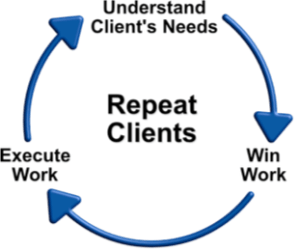
    • expand market share with existing clients…understand client interests and issues, win work, exceed expectations, repeat clients
    • develop new clients and expand transportation (roads, bridges, rail, transit, aviation, ports etc), through planning, design, construction management, CEI, program and project management, and other services as the preferred provider, including through staff augmentation
    • be a tier 1 provider of planning, design, construction, operations, maintenance, and support services
    • build image-increase visibility with various interests, including existing and new clients-legislatures, city councils, county commissions, transportation commissions, dots, aeronautics/airports, economic developers and departments, emergency management, AGC/contractors, ACEC/consultants, ASCE, AASHTO, ARTBA, ITSA, ATA, APWA, PMI, IHEEP, universities/colleges, MPOs, ACO/counties, LOM/cities, UP, BNSF, short line railroads, USDOT, FHWA, FAA, FTA, FRA, USACE, and others
    • assess the efficacy of acquisitions/mergers
    • support and collaborate with other line business sectors
    • monitor and assist growing bridge programs…design and construction
    • assess the efficacy of alternative delivery…DB, CMGC, PPP
    • assess economic stimulus of work…jobs created, taxes generated, spending/re-spending, etc
    • prepare, emphasize and execute sustainability across all business sectors
    • explore/expand:
      • teaming with contractors, consultants, and others-collaborate to win business
      • efficacy of targeted acquisitions/mergers
      • efficacy of new markets

The world is changing and we must change with it. Traditional engineering and construction are not enough.

Commit to the success of team, organization, clients, partners, and stakeholders.

Good to Great by Jim Collins, 2001, HarperBusiness, NY

Trust

05 Saturday Sep 2015

Posted by John L. Craig in Trust

≈ Leave a comment

Trust, what is it and what is it worth? I asked that question of a national railroad company executive some years ago and the immediate response was it is worth a million dollars. They did not mean that literally but they did mean that our trusting relationship was priceless and monetarily worth a lot to our mutual and individual business interests.

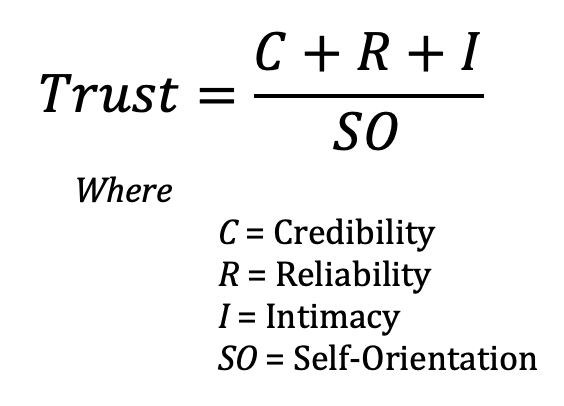
Several trust equations exist but there is one I especially like from The Trusted Advisor (October 2000) by David H. Maister, Charles H. Green and Robert M. Gailford:

EquationC credibility
R reliability
I intimacy
SO self-orientation

That is trust is greatest when the focus is on the other person versus your self-interest. That can be a fine line to walk as we all have self-interests. However, to listen, orient on, empathize with and understand someone else’s interests can open up honest and open discussions that expand ones thinking and opens the opportunity for the resolution of issues. This also serves to alleviate fear that either side is going to be taken advantage of. This usually develops an appreciation from the other person that their interests are important and respected even if resolution does not completely satisfy the interests of both parties, which it rarely does. And sometimes, middle ground is found that furthers the interest of all parties. Such is the value of trust.

“Because a thing seems difficult for you, do not think it impossible for anyone to accomplish”.

-Marcus Aurelius

Maister, David H., Charles H. Green, and Robert M. Galford. The Trusted Advisor. New York: Free, 2000. Print.

Recent Posts

  • We Will Succeed or Fail—Together: caring for our built-natural environment (Part 4 Epilogue)
  • We Will Succeed or Fail—Together: caring for our built-natural environment (Part 3 The Future: Some Background for Program Management)
  • We will Succeed or Fail—Together: caring for our built-natural environment (Part 2 A Systems Approach and Tenants for a Path Forward: Some Background for Program Management)
  • We will Succeed or Fail—Together: caring for our built-natural environment (Part 1 Setting the Stage: Some background for Program Management)
  • Program and Project Management: Three Questions

Recent Comments

Winnie's avatarWinnie on One Seamless Transportation Sy…
laneauxnaijah1990's avatarlaneauxnaijah1990 on We Will Succeed or Fail—Togeth…
Leonard's avatarLeonard on The Mobility Ecosystem: the ch…
Nora Black's avatarNora Black on Leadership: People Skills and…
jseprogrammanagement's avatarjseprogrammanagement on Program and Project Management…

Archives

  • June 2023
  • May 2023
  • April 2023
  • March 2023
  • October 2022
  • June 2021
  • April 2021
  • March 2021
  • February 2021
  • January 2021
  • May 2019
  • April 2019
  • December 2018
  • October 2017
  • September 2016
  • March 2016
  • February 2016
  • January 2016
  • September 2015

Categories

  • 3D Printers
  • 5.9 GHz
  • 5G
  • Alternative Delivery
  • Artificial Intelligence (AI)
  • Asset & Life Cycle Management
  • Augmented Reality (AR)
  • Autonomous Vehicles
  • Batteries
  • Benefit-Cost or BC
  • Biological Diversity
  • Biomimicry
  • Black Swans
  • Built Environment
  • Business Transformation
  • Clean Energy
  • Climate
  • Cloud Services
  • Collaboration
  • Communications
  • Connected and Autonomous Vehicles (CAV)
  • Construction
  • COVID-19
  • Cyber-security
  • Design
  • Design Exceptions, Practical Design, Least-Cost Planning
  • Drones
  • Dynamic Transportation Management
  • Economics
  • Economy
  • Education
  • Electric Vehicles
  • Empowering Women
  • Environment
  • Environmental Justice
  • Extinction of Species
  • Feedback Loops
  • Fuel Taxes
  • Funding
  • Funding Gaps
  • Future
  • Gas-Fueled Vehicles
  • Global Positioning Systems (GPS)
  • Governance
  • Government & Policy
  • Growth
  • History
  • Homo sapiens
  • Human Rights
  • Inequality
  • Infrastructure
  • Intelligent Infrastructure
  • Intelligent Transportation Systems or ITS
  • Internet of Things or IoT
  • Interstate
  • Investing
  • Leadership
  • Learning and Success
  • Lidar
  • Machine Control
  • Maintenance
  • Management
  • Materials
  • Mobility
  • Mobility as a Service
  • Mobility Ecosystem
  • Multimodal
  • Multimodal Needs Assessment
  • Natural Environment
  • Needs Assessments
  • Oil
  • Operations
  • Owner
  • Pandemic
  • Partnerships and Collaboration
  • Pedestrians
  • Performance Measurement and Management
  • Planning
  • Polarization
  • Poverty
  • Program Management
  • Program or Project Controls
  • Project Management
  • Recycling
  • Relationships
  • Resilience
  • Results
  • Return on Investment or ROI
  • Ride Sharing
  • Risks
  • Robotics
  • Rural
  • Safety
  • Scope, Schedule, Budget
  • Smart Cities
  • Social Justice and Equity
  • Society
  • Solar
  • Strategic Planning
  • Sustainability
  • Systems Thinking
  • Team-Building
  • Technology
  • Tipping Ponts
  • Transportation
  • Trust
  • Turn-arounds
  • Urban
  • Utilities
  • Vehicle Miles Traveled Tax (VMT)
  • Vehicle-to-Everything (V2X)
  • Vehicle-to-Infrastructure (V2I)
  • Vehicle-to-Vehicle (V2V)
  • Virtual Reality (VR)
  • Wealth
  • Well-being

Meta

  • Create account
  • Log in
  • Entries feed
  • Comments feed
  • WordPress.com

Recent Posts

  • We Will Succeed or Fail—Together: caring for our built-natural environment (Part 4 Epilogue)
  • We Will Succeed or Fail—Together: caring for our built-natural environment (Part 3 The Future: Some Background for Program Management)
  • We will Succeed or Fail—Together: caring for our built-natural environment (Part 2 A Systems Approach and Tenants for a Path Forward: Some Background for Program Management)
  • We will Succeed or Fail—Together: caring for our built-natural environment (Part 1 Setting the Stage: Some background for Program Management)
  • Program and Project Management: Three Questions

Recent Comments

Winnie's avatarWinnie on One Seamless Transportation Sy…
laneauxnaijah1990's avatarlaneauxnaijah1990 on We Will Succeed or Fail—Togeth…
Leonard's avatarLeonard on The Mobility Ecosystem: the ch…
Nora Black's avatarNora Black on Leadership: People Skills and…
jseprogrammanagement's avatarjseprogrammanagement on Program and Project Management…

Archives

  • June 2023
  • May 2023
  • April 2023
  • March 2023
  • October 2022
  • June 2021
  • April 2021
  • March 2021
  • February 2021
  • January 2021
  • May 2019
  • April 2019
  • December 2018
  • October 2017
  • September 2016
  • March 2016
  • February 2016
  • January 2016
  • September 2015

Categories

  • 3D Printers
  • 5.9 GHz
  • 5G
  • Alternative Delivery
  • Artificial Intelligence (AI)
  • Asset & Life Cycle Management
  • Augmented Reality (AR)
  • Autonomous Vehicles
  • Batteries
  • Benefit-Cost or BC
  • Biological Diversity
  • Biomimicry
  • Black Swans
  • Built Environment
  • Business Transformation
  • Clean Energy
  • Climate
  • Cloud Services
  • Collaboration
  • Communications
  • Connected and Autonomous Vehicles (CAV)
  • Construction
  • COVID-19
  • Cyber-security
  • Design
  • Design Exceptions, Practical Design, Least-Cost Planning
  • Drones
  • Dynamic Transportation Management
  • Economics
  • Economy
  • Education
  • Electric Vehicles
  • Empowering Women
  • Environment
  • Environmental Justice
  • Extinction of Species
  • Feedback Loops
  • Fuel Taxes
  • Funding
  • Funding Gaps
  • Future
  • Gas-Fueled Vehicles
  • Global Positioning Systems (GPS)
  • Governance
  • Government & Policy
  • Growth
  • History
  • Homo sapiens
  • Human Rights
  • Inequality
  • Infrastructure
  • Intelligent Infrastructure
  • Intelligent Transportation Systems or ITS
  • Internet of Things or IoT
  • Interstate
  • Investing
  • Leadership
  • Learning and Success
  • Lidar
  • Machine Control
  • Maintenance
  • Management
  • Materials
  • Mobility
  • Mobility as a Service
  • Mobility Ecosystem
  • Multimodal
  • Multimodal Needs Assessment
  • Natural Environment
  • Needs Assessments
  • Oil
  • Operations
  • Owner
  • Pandemic
  • Partnerships and Collaboration
  • Pedestrians
  • Performance Measurement and Management
  • Planning
  • Polarization
  • Poverty
  • Program Management
  • Program or Project Controls
  • Project Management
  • Recycling
  • Relationships
  • Resilience
  • Results
  • Return on Investment or ROI
  • Ride Sharing
  • Risks
  • Robotics
  • Rural
  • Safety
  • Scope, Schedule, Budget
  • Smart Cities
  • Social Justice and Equity
  • Society
  • Solar
  • Strategic Planning
  • Sustainability
  • Systems Thinking
  • Team-Building
  • Technology
  • Tipping Ponts
  • Transportation
  • Trust
  • Turn-arounds
  • Urban
  • Utilities
  • Vehicle Miles Traveled Tax (VMT)
  • Vehicle-to-Everything (V2X)
  • Vehicle-to-Infrastructure (V2I)
  • Vehicle-to-Vehicle (V2V)
  • Virtual Reality (VR)
  • Wealth
  • Well-being

Meta

  • Create account
  • Log in
  • Entries feed
  • Comments feed
  • WordPress.com

Recent Posts

  • We Will Succeed or Fail—Together: caring for our built-natural environment (Part 4 Epilogue)
  • We Will Succeed or Fail—Together: caring for our built-natural environment (Part 3 The Future: Some Background for Program Management)
  • We will Succeed or Fail—Together: caring for our built-natural environment (Part 2 A Systems Approach and Tenants for a Path Forward: Some Background for Program Management)
  • We will Succeed or Fail—Together: caring for our built-natural environment (Part 1 Setting the Stage: Some background for Program Management)
  • Program and Project Management: Three Questions

Recent Comments

Winnie's avatarWinnie on One Seamless Transportation Sy…
laneauxnaijah1990's avatarlaneauxnaijah1990 on We Will Succeed or Fail—Togeth…
Leonard's avatarLeonard on The Mobility Ecosystem: the ch…
Nora Black's avatarNora Black on Leadership: People Skills and…
jseprogrammanagement's avatarjseprogrammanagement on Program and Project Management…

Archives

  • June 2023
  • May 2023
  • April 2023
  • March 2023
  • October 2022
  • June 2021
  • April 2021
  • March 2021
  • February 2021
  • January 2021
  • May 2019
  • April 2019
  • December 2018
  • October 2017
  • September 2016
  • March 2016
  • February 2016
  • January 2016
  • September 2015

Categories

  • 3D Printers
  • 5.9 GHz
  • 5G
  • Alternative Delivery
  • Artificial Intelligence (AI)
  • Asset & Life Cycle Management
  • Augmented Reality (AR)
  • Autonomous Vehicles
  • Batteries
  • Benefit-Cost or BC
  • Biological Diversity
  • Biomimicry
  • Black Swans
  • Built Environment
  • Business Transformation
  • Clean Energy
  • Climate
  • Cloud Services
  • Collaboration
  • Communications
  • Connected and Autonomous Vehicles (CAV)
  • Construction
  • COVID-19
  • Cyber-security
  • Design
  • Design Exceptions, Practical Design, Least-Cost Planning
  • Drones
  • Dynamic Transportation Management
  • Economics
  • Economy
  • Education
  • Electric Vehicles
  • Empowering Women
  • Environment
  • Environmental Justice
  • Extinction of Species
  • Feedback Loops
  • Fuel Taxes
  • Funding
  • Funding Gaps
  • Future
  • Gas-Fueled Vehicles
  • Global Positioning Systems (GPS)
  • Governance
  • Government & Policy
  • Growth
  • History
  • Homo sapiens
  • Human Rights
  • Inequality
  • Infrastructure
  • Intelligent Infrastructure
  • Intelligent Transportation Systems or ITS
  • Internet of Things or IoT
  • Interstate
  • Investing
  • Leadership
  • Learning and Success
  • Lidar
  • Machine Control
  • Maintenance
  • Management
  • Materials
  • Mobility
  • Mobility as a Service
  • Mobility Ecosystem
  • Multimodal
  • Multimodal Needs Assessment
  • Natural Environment
  • Needs Assessments
  • Oil
  • Operations
  • Owner
  • Pandemic
  • Partnerships and Collaboration
  • Pedestrians
  • Performance Measurement and Management
  • Planning
  • Polarization
  • Poverty
  • Program Management
  • Program or Project Controls
  • Project Management
  • Recycling
  • Relationships
  • Resilience
  • Results
  • Return on Investment or ROI
  • Ride Sharing
  • Risks
  • Robotics
  • Rural
  • Safety
  • Scope, Schedule, Budget
  • Smart Cities
  • Social Justice and Equity
  • Society
  • Solar
  • Strategic Planning
  • Sustainability
  • Systems Thinking
  • Team-Building
  • Technology
  • Tipping Ponts
  • Transportation
  • Trust
  • Turn-arounds
  • Urban
  • Utilities
  • Vehicle Miles Traveled Tax (VMT)
  • Vehicle-to-Everything (V2X)
  • Vehicle-to-Infrastructure (V2I)
  • Vehicle-to-Vehicle (V2V)
  • Virtual Reality (VR)
  • Wealth
  • Well-being

Meta

  • Create account
  • Log in
  • Entries feed
  • Comments feed
  • WordPress.com

Recent Posts

  • We Will Succeed or Fail—Together: caring for our built-natural environment (Part 4 Epilogue)
  • We Will Succeed or Fail—Together: caring for our built-natural environment (Part 3 The Future: Some Background for Program Management)
  • We will Succeed or Fail—Together: caring for our built-natural environment (Part 2 A Systems Approach and Tenants for a Path Forward: Some Background for Program Management)
  • We will Succeed or Fail—Together: caring for our built-natural environment (Part 1 Setting the Stage: Some background for Program Management)
  • Program and Project Management: Three Questions

Recent Comments

Winnie's avatarWinnie on One Seamless Transportation Sy…
laneauxnaijah1990's avatarlaneauxnaijah1990 on We Will Succeed or Fail—Togeth…
Leonard's avatarLeonard on The Mobility Ecosystem: the ch…
Nora Black's avatarNora Black on Leadership: People Skills and…
jseprogrammanagement's avatarjseprogrammanagement on Program and Project Management…

Archives

  • June 2023
  • May 2023
  • April 2023
  • March 2023
  • October 2022
  • June 2021
  • April 2021
  • March 2021
  • February 2021
  • January 2021
  • May 2019
  • April 2019
  • December 2018
  • October 2017
  • September 2016
  • March 2016
  • February 2016
  • January 2016
  • September 2015

Categories

  • 3D Printers
  • 5.9 GHz
  • 5G
  • Alternative Delivery
  • Artificial Intelligence (AI)
  • Asset & Life Cycle Management
  • Augmented Reality (AR)
  • Autonomous Vehicles
  • Batteries
  • Benefit-Cost or BC
  • Biological Diversity
  • Biomimicry
  • Black Swans
  • Built Environment
  • Business Transformation
  • Clean Energy
  • Climate
  • Cloud Services
  • Collaboration
  • Communications
  • Connected and Autonomous Vehicles (CAV)
  • Construction
  • COVID-19
  • Cyber-security
  • Design
  • Design Exceptions, Practical Design, Least-Cost Planning
  • Drones
  • Dynamic Transportation Management
  • Economics
  • Economy
  • Education
  • Electric Vehicles
  • Empowering Women
  • Environment
  • Environmental Justice
  • Extinction of Species
  • Feedback Loops
  • Fuel Taxes
  • Funding
  • Funding Gaps
  • Future
  • Gas-Fueled Vehicles
  • Global Positioning Systems (GPS)
  • Governance
  • Government & Policy
  • Growth
  • History
  • Homo sapiens
  • Human Rights
  • Inequality
  • Infrastructure
  • Intelligent Infrastructure
  • Intelligent Transportation Systems or ITS
  • Internet of Things or IoT
  • Interstate
  • Investing
  • Leadership
  • Learning and Success
  • Lidar
  • Machine Control
  • Maintenance
  • Management
  • Materials
  • Mobility
  • Mobility as a Service
  • Mobility Ecosystem
  • Multimodal
  • Multimodal Needs Assessment
  • Natural Environment
  • Needs Assessments
  • Oil
  • Operations
  • Owner
  • Pandemic
  • Partnerships and Collaboration
  • Pedestrians
  • Performance Measurement and Management
  • Planning
  • Polarization
  • Poverty
  • Program Management
  • Program or Project Controls
  • Project Management
  • Recycling
  • Relationships
  • Resilience
  • Results
  • Return on Investment or ROI
  • Ride Sharing
  • Risks
  • Robotics
  • Rural
  • Safety
  • Scope, Schedule, Budget
  • Smart Cities
  • Social Justice and Equity
  • Society
  • Solar
  • Strategic Planning
  • Sustainability
  • Systems Thinking
  • Team-Building
  • Technology
  • Tipping Ponts
  • Transportation
  • Trust
  • Turn-arounds
  • Urban
  • Utilities
  • Vehicle Miles Traveled Tax (VMT)
  • Vehicle-to-Everything (V2X)
  • Vehicle-to-Infrastructure (V2I)
  • Vehicle-to-Vehicle (V2V)
  • Virtual Reality (VR)
  • Wealth
  • Well-being

Meta

  • Create account
  • Log in
  • Entries feed
  • Comments feed
  • WordPress.com

Blog at WordPress.com.

  • Subscribe Subscribed
    • Leadership in Transportation
    • Already have a WordPress.com account? Log in now.
    • Leadership in Transportation
    • Subscribe Subscribed
    • Sign up
    • Log in
    • Report this content
    • View site in Reader
    • Manage subscriptions
    • Collapse this bar
 

Loading Comments...